2026 Influencer Marketing Budgets: How are Brands Allocating Spend?

Learn how brands are allocating influencer marketing budgets in 2026, including spend ranges, performance priorities, and cost-efficient strategies.
Influencer marketing has evolved into a core growth channel, driven by strong consumer resonance and proven performance. As a result, budgets are rising. US influencer marketing spend is projected to grow 15.7% in 2026 and reach $13.7B by 2027.
Data from our latest report, The State of Influencer Marketing 2026, reveals a mix of confidence and discipline in how brands are planning their investments for the year ahead. Marketers are increasing spend, but they are also becoming more deliberate about how those dollars are allocated and measured.
Let’s take a closer look at where budgets are growing, how spend levels differ across brands, and what strategies marketers are using to maximize returns in an increasingly competitive environment.
Influencer marketing budgets are growing, with wide ranges in spend.
Influencer marketing continues to take up a larger share of overall marketing budgets. Last year, brands allocated an average of 23% of their total marketing budgets to creator partnerships. That share is expected to rise again in 2026, with 74% of marketers planning to increase their influencer marketing budgets.
Even with this growth, budget levels vary significantly from brand to brand. According to our report, annual influencer marketing budgets break down as follows:
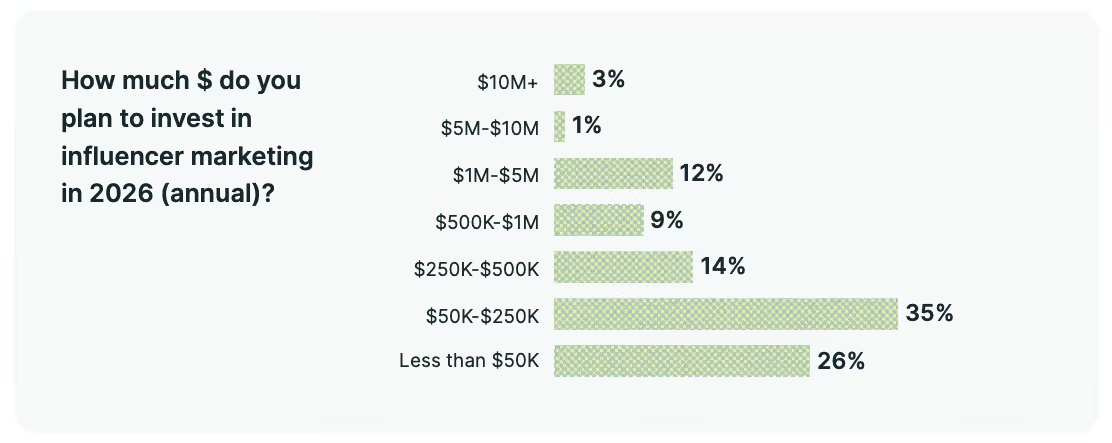
Most programs still live below the $250K mark, representing 61% of respondents. However, this does not signal reduced confidence in the channel. Instead, it reflects influencer marketing’s growing cost efficiency compared to traditional media. Creator partnerships allow brands to reach highly engaged audiences at a fraction of the cost of channels like TV or display advertising, where CPMs often reach double digits.
In many cases, influencer content delivers comparable or stronger performance without the production costs and media inflation that come with large scale traditional buys. Brands can generate meaningful impact without needing budgets that mirror legacy advertising spend.
At the same time, a notable 16% of brands now manage multi-million dollar influencer marketing programs. This range shows how the channel scales across business sizes and objectives, from lean efficiency driven programs to large investments tied directly to revenue growth, paid media performance, and long term brand storytelling.
How are brands maximizing their influencer marketing budgets?
Rising budgets do not mean looser spending. Amid economic uncertainty, marketers are leaning toward efficiency, accountability, and flexibility. Their strategies focus on 3 major themes:
1. Leveraging cost-effective strategies
Many brands are shifting toward lower risk and higher leverage structures such as affiliate programs, gifting campaigns, and user-generated content that can be reused across paid channels. These types of partnerships help protect budget while still supporting scale, especially when paired with clear performance benchmarks.
To stretch budgets further, brands are:
- Negotiating more actively with creators and setting clear budget expectations
- Adopting performance-based compensation models
- Securing more value per partnership through ad rights, raw files, and multi platform usage
- Limiting upfront fees and paying for ad usage only when needed
These approaches allow brands to not only maintain content volume without increasing fixed costs, but also create stronger links between spend and measurable outcomes — which leads us to our next theme.
2. Prioritizing measurable performance
Measurement now sits at the center of budget decisions. Brands are moving away from broad awareness metrics and focusing on signals tied directly to business results.
Many teams:
- Evaluate creators based on recent performance data rather than historical reach
- Build CPC and CAC projections before committing to larger partnerships
- Run smaller pilot campaigns before scaling spend
Creator selection strategies are also evolving. Brands increasingly favor mid-tier and micro creators with proven engagement and outcomes, and investing in content formats that convert, such as native, lo-fi style videos and searchable formats that perform well across platforms.
In short, budgets expand only when data consistently supports continued investment.
3. Investing in authentic, story-driven content
Beyond efficiency and analytics, brands are rethinking how they collaborate with creators. Instead of relying on one off activations, many teams are building ongoing partnerships designed to produce consistent and credible content.
Long term creator relationships help brands:
- Reduce onboarding and sourcing costs over time
- Improve content quality through familiarity and creative trust
- Strengthen audience credibility by working with genuine brand advocates
Giving creators more creative freedom also benefits performance. When creators feel trusted, the content feels more natural and aligns better with audience expectations. These relationships often lead to lower rates, higher content quality, and stronger long term results.
For many brands, creator partnerships now function more like retained creative teams than short term media buys. This structure supports both storytelling and sustained performance while keeping budgets predictable and efficient.
What do these budget trends signal for 2026?
The data reveals that the industry is in transition. Growth remains strong, but expectations have changed. Marketers want creator programs that scale, perform, and integrate across channels.
The wide spread of budget levels shows that influencer marketing works at many stages of business maturity. Small teams can launch lean programs built on gifting and affiliate models. Large organizations can justify seven figure investments tied to paid media, ecommerce performance, and brand lift.
The unifying factor across all levels is intention. Brands are not spending more simply to post more. They are spending more to extract value from every partnership, every asset, and every conversion path.
For more insights into trends and strategies, download The State of Influencer Marketing 2026.