How to Run a Successful Product Gifting Campaign with Influencers

Learn how to run an influencer gifting campaign that earns posts and sales: 7 steps, a sample timeline, cost-per-post math, and real brand examples.
Swimwear brand Kulani Kinis spent $42,000 on influencer gifting. That budget went out as product to 600 creators across eight collection launches, and it came back as 280 million impressions and $12.8 million in awareness value, without a single creator fee or posting contract.
Now picture the version of a product seeding program most teams run: a few hundred PR boxes pulled from a database list, a handful of polite "thanks for the gift!" Stories, and a finance team asking why the product budget produced 20 posts.
The gap between those two outcomes has very little to do with budget. It comes down to how the influencer gifting campaign is built: who gets product, how they're asked, what's in the box, and what the team measures when the posts come back. And creators are more open to gifting than most marketers assume. 86% of creators say they'll work for free product when the brand or product is the right fit.
This guide walks through how to run an influencer gifting campaign that holds up in a budget review, step by step, with a sample timeline, a cost-per-post example, real campaign results, and what to look for in an influencer gifting platform once you're ready to scale.
Key takeaways
- An influencer gifting campaign is a planned send of free product to a selected group of creators, usually with no posting requirement, to drive content, awareness, and sales.
- Post rate is the number that makes or breaks your ROI. Cold, unrequested sends often land in the single digits. Opt-in sends to well-matched creators routinely clear 50%.
- Budget by cost per post, not cost per box. A $60 box with a 25% post rate costs $240 per post. The same box at 65% costs about $92.
- Nano and micro creators are the engine of most gifting programs, with the highest engagement and the most enthusiasm for product-only collaborations.
- Gifted content still needs a disclosure. The FTC requires creators to disclose free product, even when no post was required.
What is an influencer gifting campaign?
An influencer gifting campaign is a coordinated send of free products to a curated group of creators, timed to a launch or campaign moment, with the goal of earning organic posts, reviews, and content without paying a creator fee. Most gifting campaigns are termless, which means creators aren't obligated to post. The brand earns coverage by sending something the creator actually wants to talk about.
You'll also hear influencer gifting called product seeding, PR gifting, or sending PR packages. They all describe the same tactic. For a deeper look at building it into an always-on program, see our guide to product seeding.
Termless vs. termed gifting
Termless gifting is the default. You send the product, share what you'd love to see, and leave the decision to post up to the creator. It keeps the collaboration authentic and keeps your costs down.
Termed gifting attaches light expectations, such as one in-feed post or three Stories, in exchange for the product. It makes sense when the product itself is high value (furniture, appliances, luxury goods) and the gift is effectively the creator's fee. If you go termed, put the terms in writing before anything ships.
Does influencer gifting still work in 2026?
It's a fair question. Creator rates keep rising, pay-to-play has become the norm at the top of the market, and plenty of marketers believe gifting only works for brands that are already famous.
The data says otherwise, with one important condition: gifting works when it's targeted. Kulani Kinis' 280 million impressions came from a $42,000 product investment. SKINN Cosmetics grew its seeding program from 30 to 50 creators to hundreds and saw a 19% lift in web traffic from social alone. When Rugs USA gifted product from its collaboration with designer Arvin Olano, creators generated 2,700+ posts and 40 million impressions with no content requirement at all.
What has stopped working is the spray-and-pray approach, where your brand mass sends to creators who never asked for the product, don't fit the category, and have no reason to post. So, gift with intention. Every box should have a clear reason to be in that creator's hands.
How to run an influencer gifting campaign in 7 steps
Step 1: Pick one primary goal and the metric that proves it
Every influencer gifting campaign should answer one question for leadership. "Build buzz" isn't a goal you can defend. Choose the outcome that matters most for this send, then pick the metric you'll report on.
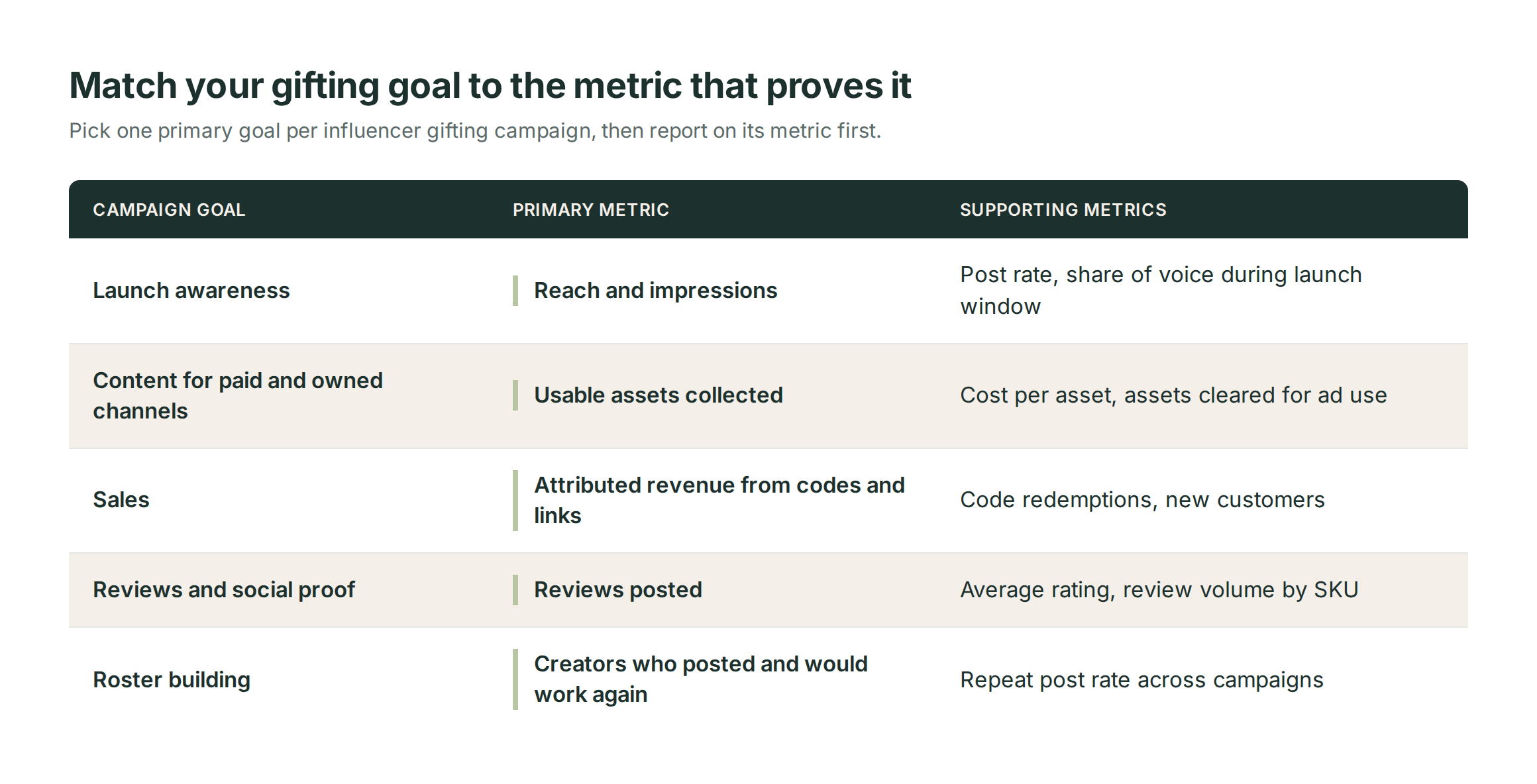
You'll track most of these regardless. Naming one as primary keeps the creator list, the insert card, and the final report pointed in the same direction.
Step 2: Choose the product and budget the full cost per box
Not every SKU makes a good gift. The strongest gifting products are visual (easy to show on camera), have a clear "before and after" or reaction moment, or fit naturally into a creator's routine. Hero products and new launches usually outperform accessories.
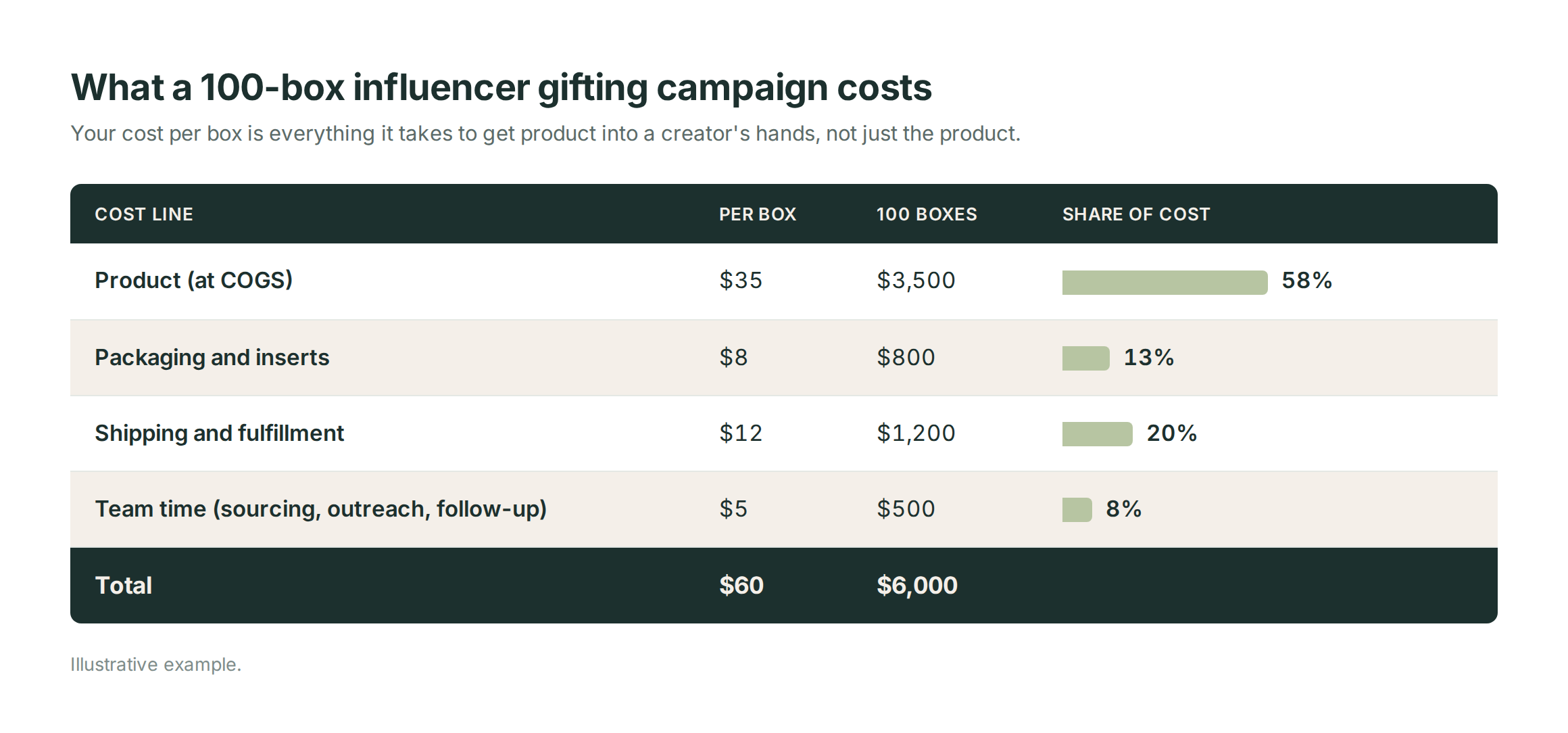
Then do the math most teams skip. Your cost per box isn't the retail price of the product. It's everything it takes to get a box into a creator's hands:
- Product at cost of goods (COGS)
- Packaging and inserts
- Shipping and fulfillment
- Team time to source, confirm, and follow up
That total is the number you'll divide by posts later. More on that in the worked example below.
Step 3: Build a creator list with high intent
Your creator list determines your post rate more than any other variable. The best gifting lists pull from warm sources first:
- Creators already tagging your brand: They've shown they'll post about you unprompted.
- Customers who create content: Your email list and loyalty program are full of people with engaged followings who already love the product.
- Past gifting recipients who posted: Your most reliable performers from previous campaigns should get first access.
- Creators who've opted into gifting: Marketplaces where creators signal interest in product collaborations save you from pitching people who only take paid deals.
For most brands, the core of the list should be nano and micro creators. Based on our platform data, nano creators average a 6.29% engagement rate versus 1.80% for mega creators, and smaller creators consistently show the most enthusiasm for product-only collaborations. A mix works well for launches. Seed to a large base of nano and micro creators for volume and authenticity, plus a few larger creators where a reaction video could move the needle.
And before anyone goes on the list, check three things: the audience matches your customer, the content style fits your brand, and the engagement looks real.
Step 4: Ask before you ship
The single fastest way to raise your post rate is to stop sending unrequested boxes. With a short opt-in message, you can confirm the creator’s interest, collect the right shipping address, and get a soft "yes" before you spend a dollar.
Keep outreach short and specific. For example:
Hi [Name], we've loved your [specific content] and think our new [product] would fit right into your [routine/space]. We'd love to send you one, no strings attached. Want us to ship it your way? If so, pick your favorite from our new collection here: [link].
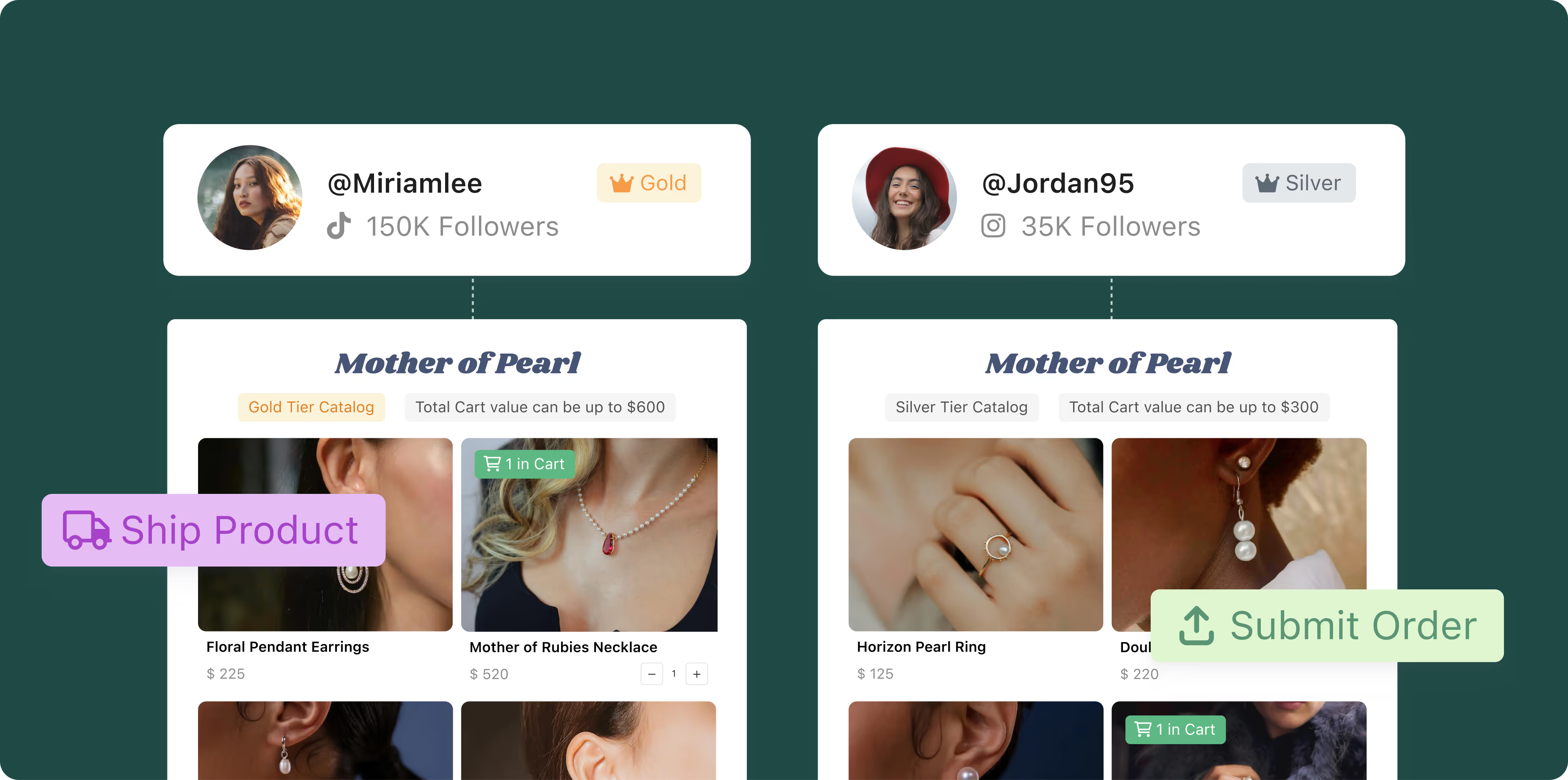
Letting creators choose their product is one of the highest-leverage moves in gifting. A creator with curly hair needs a different formula than one with straight hair. Someone who wears an XS needs a different size than someone who wears an XL. When creators pick from a curated catalog, they get something they'll actually use, and the content that comes back is more genuine because the reaction is real.
Step 5: Design an unboxing worth posting
A memorable unboxing gives creators a reason to hit record, and a thoughtful insert gives them just enough direction to make the post easy.
On the packaging side, personalization goes further than price. Rare Beauty's PR package for its Positive Light collection included custom initial earrings for each creator, a small touch that turned a product send into a moment worth filming. Handwritten notes, a creator's name on the box, or eco-friendly packaging that feels considered all help.
Inside the box, include a soft brief. Think of it as a short card that gives creators direction without scripting them. It should cover:
- Why now? Include why this product is important, whether it’s for a big launch, or if there’s a story behind the product
- 2-3 content ideas based on angles other creators have used well
- Your handle and campaign hashtag, so you can find and track the content
- A personal discount code or affiliate link if the creator wants to earn from sales
- A disclosure note as a friendly reminder on how to label gifted content
- A heads-up on content reuse that lets creators know you'd love to feature great content, with a clear path to formal usage rights
Step 6: Ship, follow up, and handle disclosure
Send tracking details as soon as each order ships, then follow up once the product has arrived. A simple check-in a few days after delivery ("Did everything arrive okay? Let us know what you think!") lifts post rates without pressuring anyone. After that, give creators room. One or two touches is plenty for a termless send.
On disclosure, gifted content isn't exempt. Under the FTC's guidance for influencers, creators must disclose free products when they mention a brand, even if they weren't asked to post. The FTC's examples include clear language like "Thanks to [Brand] for the free product," "ad," or "sponsored," along with platform tools such as paid partnership labels. Vague terms don't hold up well, so it's worth recommending wording explicitly rather than relying on creators to guess. If you run programs outside the US, check local advertising rules as well.
Step 7: Measure, then reinvest in your top performers
Post rate alone won't defend a gifting budget. Report on 4 numbers after every influencer gifting campaign:
- Post rate: the share of recipients who posted within 30 days of delivery.
- Cost per post: total campaign cost divided by posts.
- Content value: how many assets are usable across paid ads, email, product pages, and social, and what they'd have cost to produce.
- Attributed sales: revenue and new customers from creator codes and links.
Then act on what you learn. Tag the creators who posted, prioritize them for your next send, and consider moving your best performers into paid or ambassador partnerships. Quietly stop sending to the ones who didn't engage. After 3 or 4 campaigns, you'll have a roster of creators who reliably post when product arrives, and every future gifting campaign starts from a much stronger baseline.
Sample influencer gifting campaign timeline
For a product launch, work backward from the date you want content to go live.
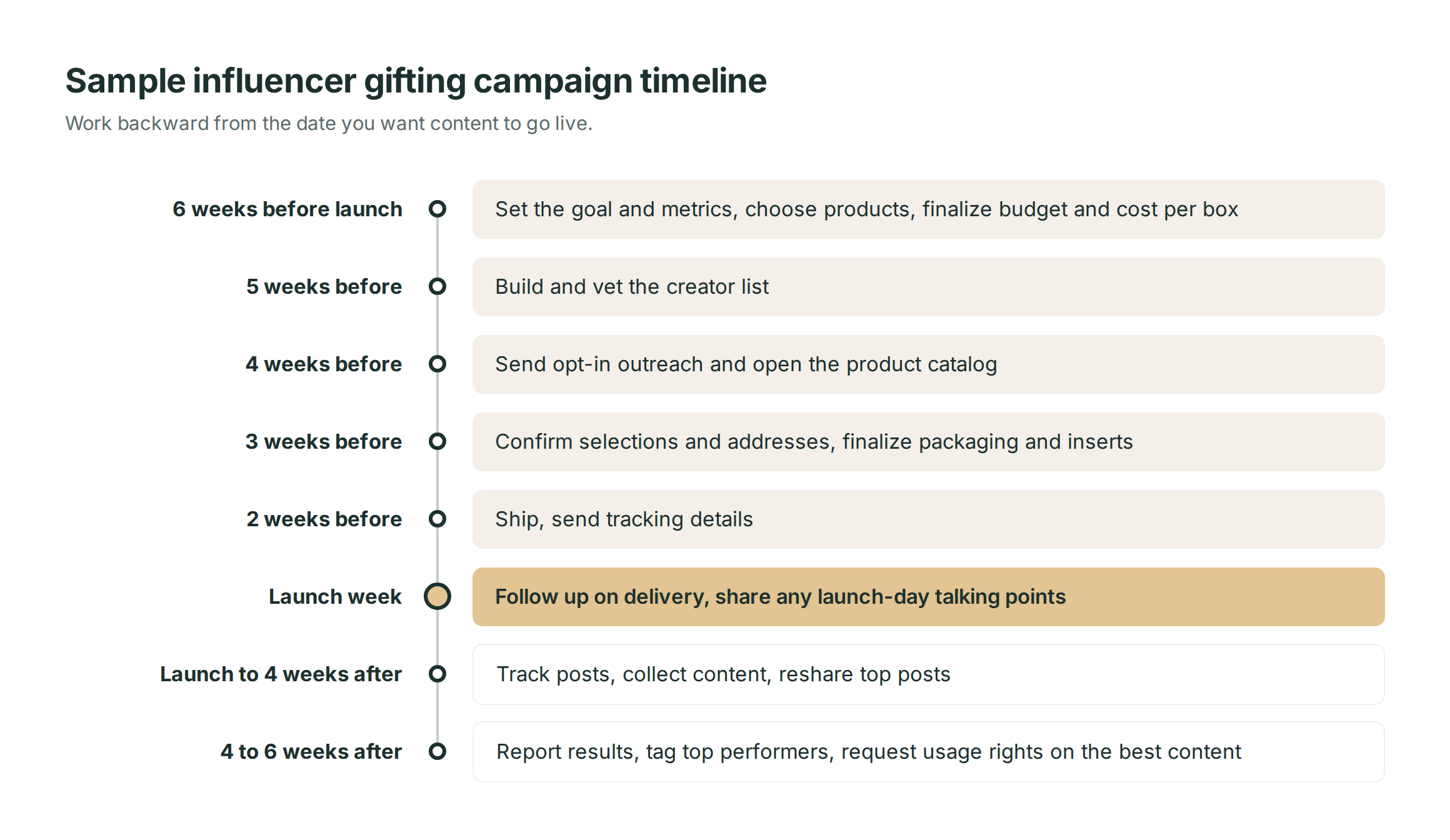
If there's no embargo, you can compress this. If there is one, build in extra buffer so product lands before the embargo lifts, and state the date clearly on the insert card.
What does an influencer gifting campaign cost?
The short answer is your cost per box divided by your post rate. Here's an illustrative campaign sending 100 boxes:
Now look at how post rate changes the economics:
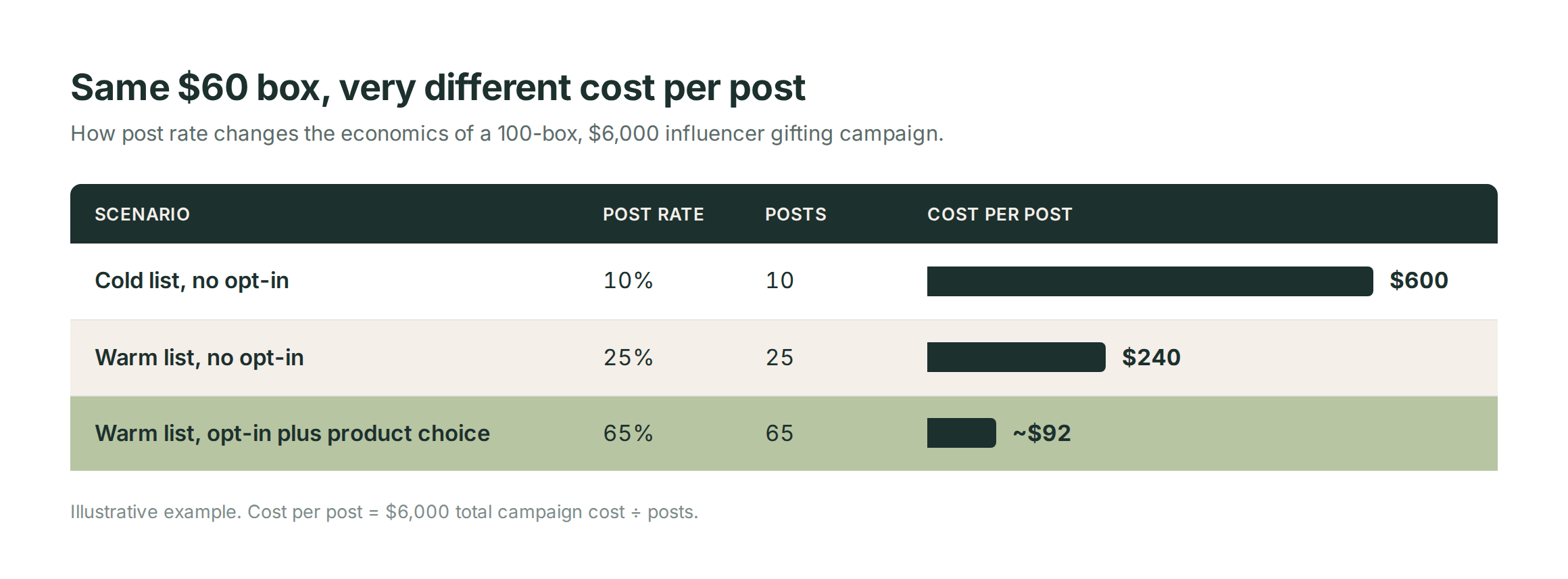
The box and the budget stay the same, but cost per post changes by 6.5x. That spread is why steps 3 and 4 matter more than packaging, product choice, or creator tier. It's also a useful gut check against paid content. Put your cost per post next to the sponsored post rates in our How Much to Pay Influencers guide to see where gifting outperforms and where a paid deal is the better buy.
Influencer gifting campaign examples
Kulani Kinis: 600 creators, eight launches, $42K
Kulani Kinis built gifting into every collection launch, eight times a year. Using curated product catalogs, the team let hundreds of creators per launch pick the pieces they wanted, then tracked content as it came in. The result: 280 million impressions and $12.8 million in awareness value from $42,000 in gifted product.
What to borrow: Consistency pays off. Gifting on a predictable launch cadence turns one-time recipients into creators who expect, and look forward to, the next drop.
Rugs USA: letting the collab do the talking
When Rugs USA launched a collection with interior designer Arvin Olano, the brand gifted product to creators in the home and design space without requiring any content. The excitement around the collaboration carried it: 2,700+ posts and 40 million impressions.
What to borrow: A strong story behind the product, like a designer collab or a limited drop, gives creators a reason to post that no brief can manufacture.
SKINN Cosmetics: scaling from dozens to hundreds
SKINN started with 30 to 50 creators and scaled its seeding program to hundreds. The brand saw 4.1 million in reach, 7x growth in total media value, and a 19% increase in web traffic from social. A single macro creator's mention of its Luminous Skin Oil drove a 192% month-over-month jump in sales for that product.
What to borrow: Start small, learn who posts, then scale. One well-placed larger creator on top of a strong nano and micro base can spike sales for a specific SKU.
Common influencer gifting mistakes
- Sending without asking: Unrequested boxes are the biggest driver of low post rates and wasted product.
- One-size-fits-all kits: The wrong shade, size, or flavor won’t get you any posts.
- No insert or direction: Creators who don't know the story behind the product struggle to make content about it.
- Skipping disclosure guidance: Improper disclosure puts both the creator and the brand at risk.
- Measuring only post rate: Without cost per post and content value, the program looks like a cost center.
- Forgetting to reinvest: Creators who posted once are your best bet for the next campaign. Treat them that way.
- Running it all in spreadsheets: Addresses in one doc, orders in Shopify, DMs in three inboxes. It works at 20 creators but breaks at 200.
What to look for in an influencer gifting platform
At a few dozen creators, a spreadsheet and a Shopify admin can get you through. Past that, the operational load (address collection, order creation, tracking, content capture) starts eating the time you should spend on strategy. That's where an influencer gifting platform earns its place.
When you evaluate options, look for:
- Ecommerce integration: Orders should sync directly with your store so products, inventory, and fulfillment stay in one system.
- Creator-choice catalogs: Creators should be able to pick products themselves, with limits on items, value, and eligible SKUs.
- Built-in creator discovery: There should be tools to find well-aligned creators, including creators who've opted into gifting, plus a way to find people already posting about you.
- Automatic content tracking: The platform should capture posts that tag your brand even when creators don't submit them manually.
- Codes, links, and sales attribution: There should be a way for gifting to be measured against revenue, not only reach.
- A creator CRM: Top performers can be tagged, allowing you to build your roster campaign over campaign.
- Usage rights workflows: Great gifted content should be able to move seamlessly into paid ads without a separate email chain.
- Scale without extra headcount: The workflow for 50 boxes should be the same as the workflow for 5,000.
How Aspire helps you run influencer gifting campaigns at scale
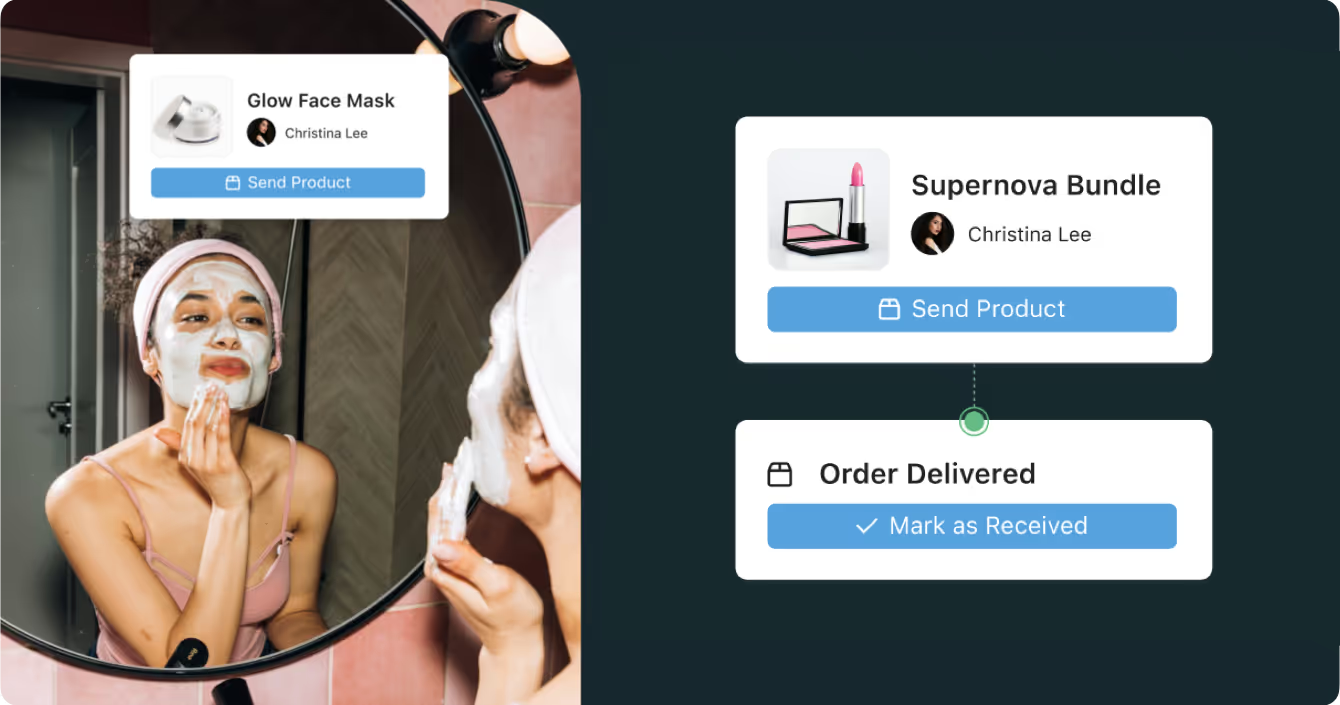
Aspire's product seeding and gifting tools connect directly to Shopify, so you can import products, organize them into collections, and ship gifting orders without the spreadsheet chaos. Creators choose what they want from a curated catalog, with limits by product tag, item count, and value. Orders sync to Shopify for fulfillment, and tracking flows back to creators automatically.
Once the product lands, Aspire captures the content, including organic posts that tag your brand, and ties it to promo codes and links so you can report post rate, content, and sales in one place. Your top performers get tagged in your creator CRM for the next campaign, and discovery through the Creator Marketplace makes it easy to find creators who are specifically interested in gifting.
If you’re short on bandwidth, Aspire's agency services team can run your gifting program end to end, from sourcing and outreach to fulfillment and reporting.
Ready to turn your next product launch into hundreds of creator posts? Book a demo to see how Aspire runs influencer gifting at scale.
Frequently asked questions
What is influencer gifting?
Influencer gifting is when a brand sends free products to creators in the hope they'll share them with their audience. It's usually termless, meaning creators aren't required to post. Brands use influencer gifting to drive awareness, generate content and reviews, and build relationships with creators they may later pay or bring into an ambassador program.
How do you run a successful influencer gifting campaign?
Set one primary goal, budget the full cost per box, build a list of well-matched creators from warm sources, ask creators to opt in before you ship, let them choose their product, include a soft brief in the box, follow up once after delivery, and report on post rate, cost per post, content value, and sales. Then reinvest in the creators who posted.
What is a good post rate for an influencer gifting campaign?
Cold, unrequested sends often land around 10% or lower. In PR, 20% to 50% is often considered a successful take rate for warm lists. Campaigns that combine a well-matched list, an opt-in step, and creator product choice can reach 60% or higher, and some agencies report 80% or more with established creator relationships.
How much does an influencer gifting campaign cost?
Cost depends on product value, packaging, shipping, and team time. A campaign sending 100 boxes at a $60 all-in cost per box runs $6,000. The more useful number is cost per post. At a 25% post rate that's $240 per post, and at 65% it drops to about $92.
Do influencers have to disclose gifted products?
Yes. In the US, the FTC says creators should disclose when they've received free or discounted products from a brand they mention, even if they weren't asked to post. Clear wording like "Thanks to [Brand] for the free product," "ad," or a platform's paid partnership label works. Brands should share disclosure guidance with every creator they gift.
Which influencers should you send PR packages to?
Prioritize creators already tagging your brand, customers with engaged followings, past recipients who posted, and creators who've opted into gifting. Nano and micro creators usually deliver the best results, since they have the highest engagement rates and are the most receptive to product-only collaborations.
What is an influencer gifting platform?
An influencer gifting platform is software that manages the logistics of sending products to creators: creator discovery, product catalogs, address collection, order creation through your e-commerce store, shipment tracking, content capture, and performance reporting. It lets brands run gifting campaigns for hundreds or thousands of creators without spreadsheets.
Should influencer gifting be termless or require a post?
For most products, termless gifting works best because it keeps content authentic and costs low. Termed gifting, where a creator agrees to specific deliverables in exchange for the product, makes more sense for high-value items like furniture or luxury goods where the product is effectively the creator's fee.