5 Steps to Integrate Creator Content in Paid Ads

Discover 5 data-driven tactics for influencer marketing in paid advertising, from creator rights and testing to measurement and scalable growth.
Creator content is becoming a core source of paid-media creative. 77% of brands say they use influencer content in paid social ads.
Influencer marketing in paid advertising means putting paid media budget behind creator-produced assets. The creator supplies the voice, perspective, and audience credibility. Meanwhile, the brand supplies targeting, budget, campaign objectives, and performance measurement.
The 5 steps below follow campaign dependency and risk. Start with legal and operational readiness, validate creative before spending, adapt it for each placement, run controlled tests, and scale proven assets.
What are the 2 ways to activate creator content in paid media?
An organic creator post is the original asset published to a creator’s account. It lets the brand observe audience response before deciding whether to invest in paid distribution.
Comments, shares, saves, and watch time usually reveal more about attention and intent than likes alone. These signals help identify promising assets, although paid testing must still confirm their advertising value.
From there, brands have 2 main activation paths. They can license and adapt the content for ads delivered through the brand’s account, or fund ads that run from the creator’s profile.
Repurposed creator content in brand-run ads
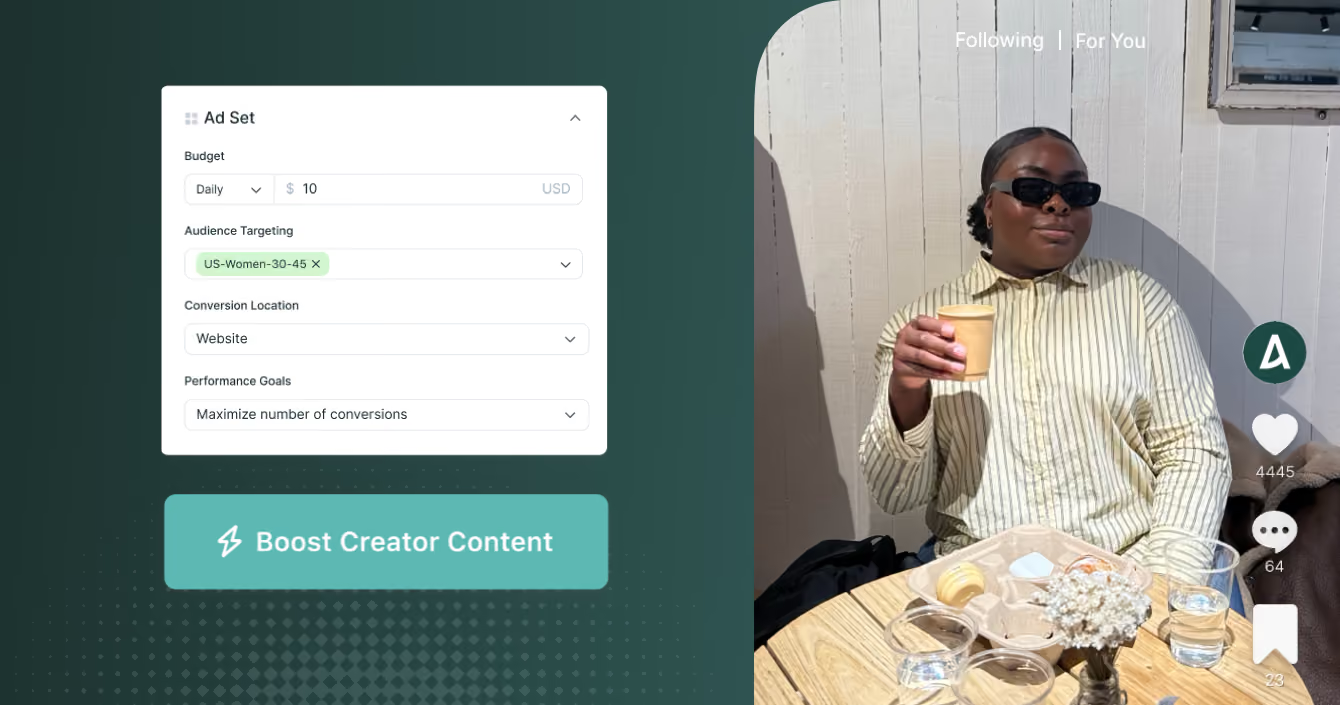
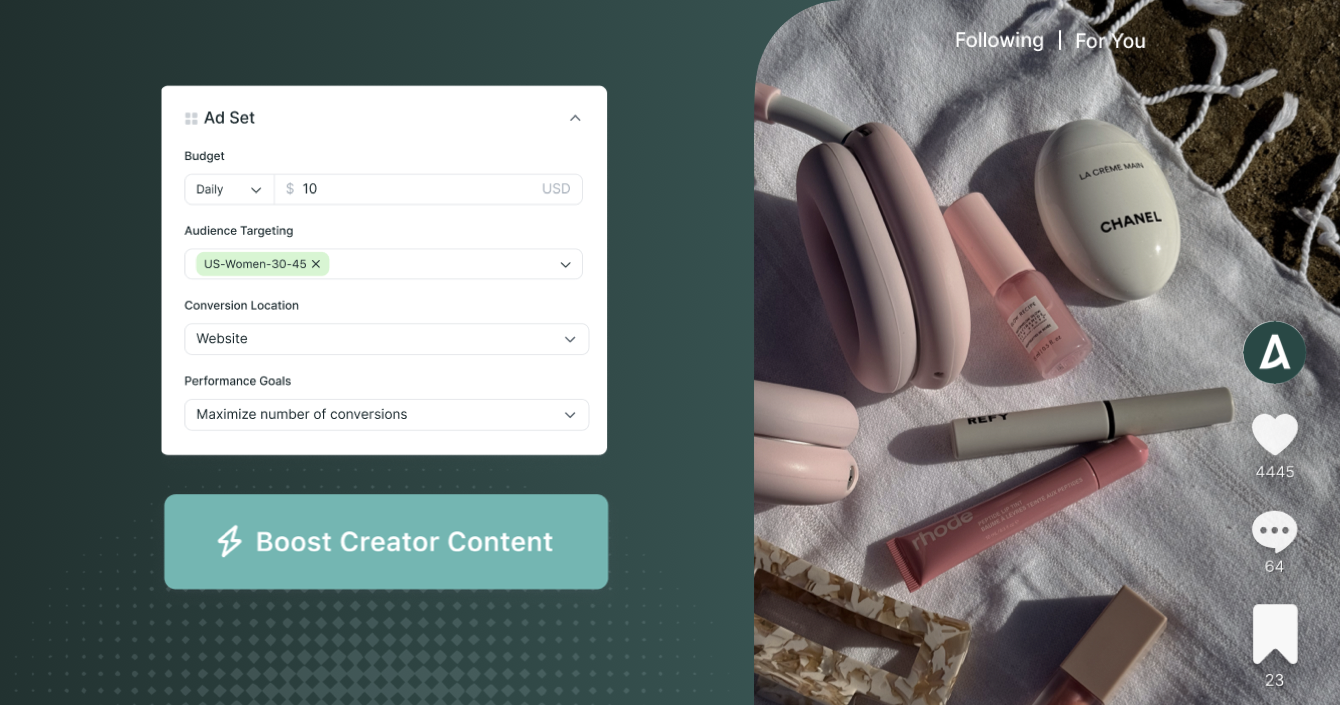
Repurposed creator content is licensed material that the brand adapts and delivers through its own advertising account. The brand controls the campaign structure, audience, budget, placement, and call to action.
A single creator video can produce several paid assets. The brand might extract static frames, create shorter cuts, add captions, change the opening hook, or crop the content for different placements. This variation process gives teams more ways to test one creator concept.
Brand-run ads fit campaigns that require direct creative control, established account structures, or close alignment with existing acquisition programs. They also make it easier to compare creator content with studio-shot brand creative under the same delivery conditions.
Allowlisted ads through creator handles
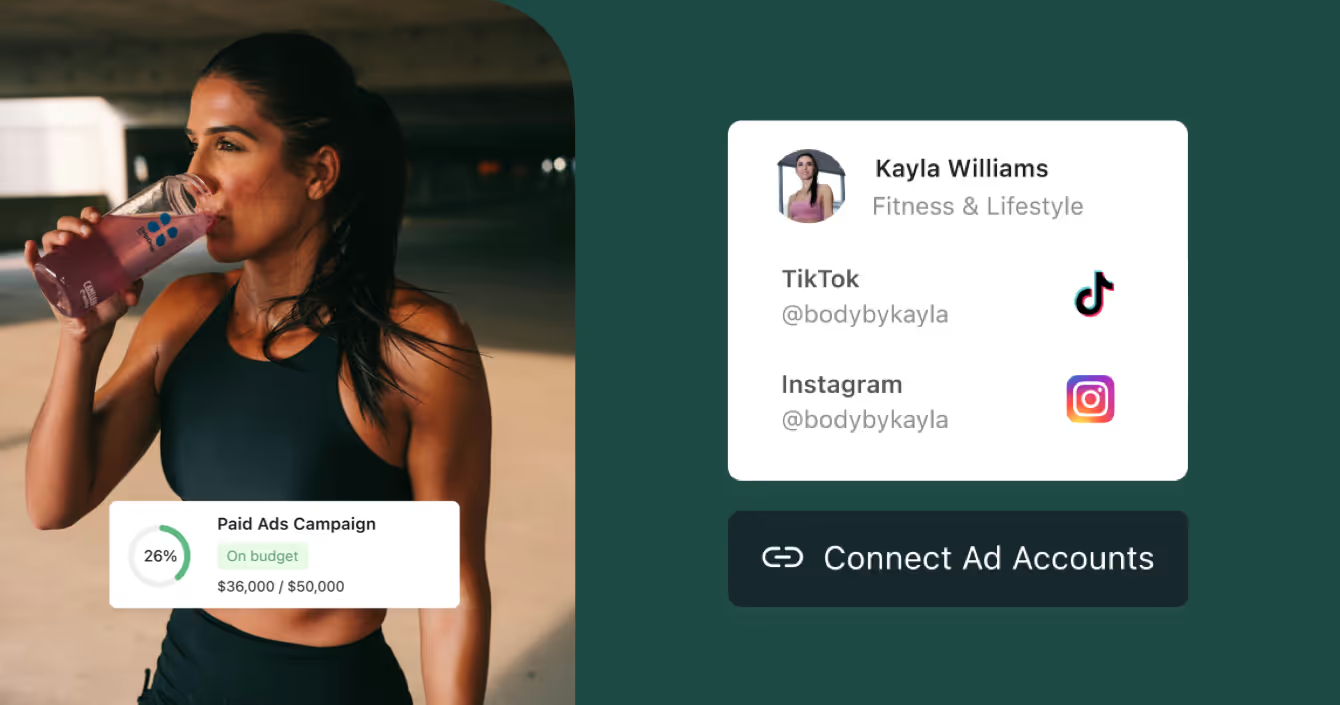
Creator-handle ads are funded and targeted by the brand but displayed from a creator’s profile. Native formats include Meta Partnership Ads, TikTok Spark Ads, and YouTube Creator Partnerships Boost.
These ads carry a paid-partnership label and retain the creator identity attached to the content. That identity may provide useful social context, while the advertising platform gives the brand paid reach and targeting controls. Each platform has its own creator-led paid format and activation workflow.
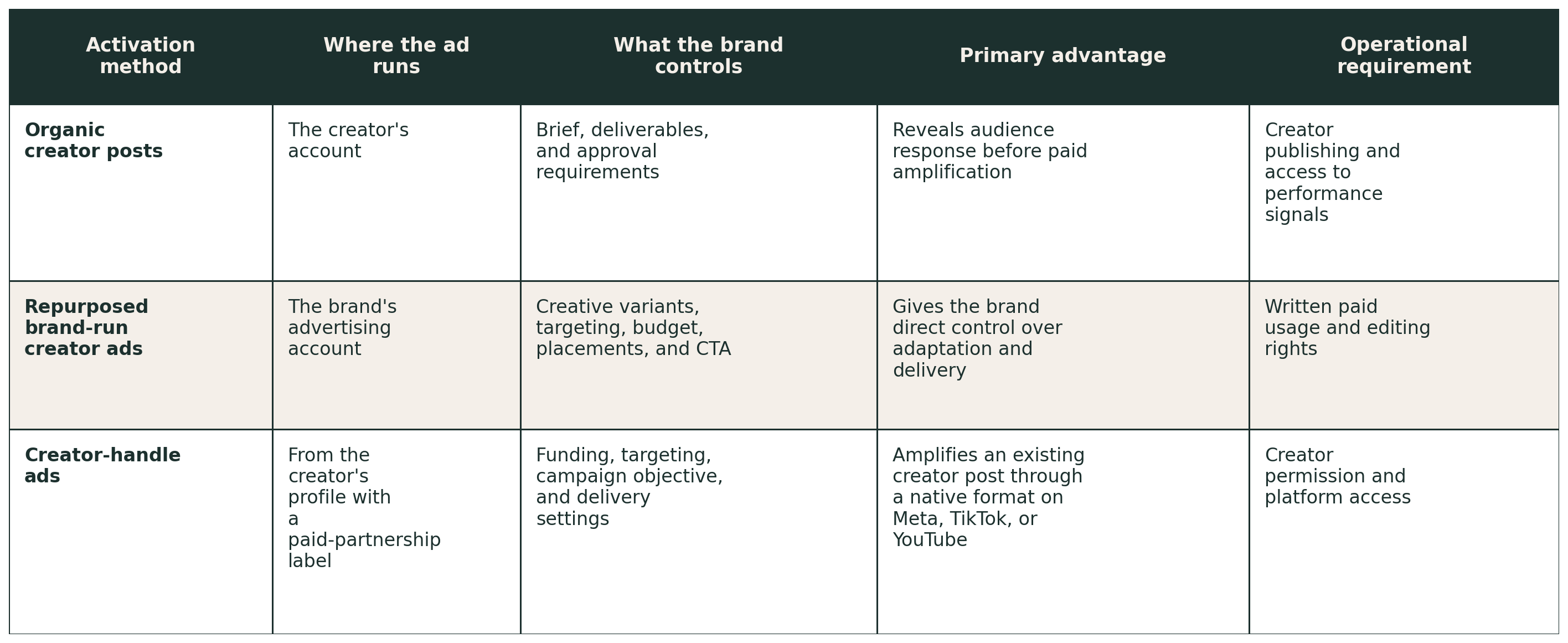
None of these formats is a universal winner. Use the testing framework in Step 4 to compare brand-run ads, creator-handle ads, and individual creative treatments under controlled conditions.
Step 1: Build paid usage rights and measurement into the creator brief
Rights come first because a brand cannot legally use creator content in a paid ad without explicit permission. Handle those permissions before production rather than renegotiating after a post performs well.
The agreement also needs to support measurement. Tracking links, codes, campaign identifiers, and reporting responsibilities become harder to add after content goes live. Aspire’s rights-first paid media workflow connects these requirements before amplification begins.
Choose creators for paid performance, not follower count alone
Follower count shows potential reach, but it says little about whether a creator can make effective advertising creative. It’s even less relevant when it comes to paid ads, where you’re spending to target specific segments. Review audience overlap, content style, engagement patterns, brand fit, and brand safety.
Look closely at how the creator introduces products. A creator who can demonstrate a product naturally may fit consideration campaigns, while a strong storyteller may suit awareness creative. Their usual format should also match the placements you plan to buy.
The selection process should examine:
- Audience demographics and overlap with the intended buyer
- Recurring topics, visual style, and content format
- The quality and substance of audience responses
- Past product integrations and calls to action
- Brand values, safety concerns, and category fit
- Ability to follow mandatory claims and disclosure requirements
A useful brief gives the creator a defined communication goal without writing every sentence for them. Creator selection and direction should protect the creator’s natural style while meeting brand requirements.
Set rights, disclosure, approval, and tracking requirements before production
Every creator agreement should state where, how, and for how long the brand may use the content. Brands typically negotiate a usage period of 6 to 12 months, although the right term depends on the campaign and agreement.
Address these paid-media terms in writing:
- Approved advertising channels
- Permission for paid promotion and boosting
- Usage duration and renewal terms
- Permission to crop, edit, or remix the content
- Geographic restrictions, where relevant
- Disclosure responsibilities
- Brand and creator approval stages
- Platform permissions for creator-handle ads
The working creator brief should then connect those rights to production and measurement:
- Campaign objective
- Product messages and intended audience
- Mandatory claims and compliance guardrails
- Platform deliverables and file specifications
- Raw-file delivery or editing permissions
- Paid usage terms
- Tracking-link and promo-code assignments
- Disclosure ownership
- Approval stages and reviewers
- Final handoff deadline
Influencer marketing software can keep the operational pieces connected. This includes discovery, vetting, creator relationship management, contracts, approvals, content collection, tracking, paid amplification, reporting, payments, and renewals.
Aspire supports unique affiliate links, promo codes, paid-ad boosting, and flat, percentage-based, or tiered commission structures. Those capabilities help teams maintain creator-level identifiers from the initial brief through the final performance report.
Step 2: Use organic performance to select creative worth paying to scale
Organic creator content is a low-cost validation layer. It gives the audience an opportunity to respond before the brand commits paid budget, while paid testing determines whether that response translates into campaign results.
Read the signals that matter
Start with comments, shares, saves, and watch time. These intentional behaviors can show whether viewers understood the message, found the content useful, or stayed long enough to absorb the product story.
Likes provide context, but they should not drive selection alone. Organic performance is a useful signal rather than proof that the same asset will produce efficient paid conversions.
Use a repeatable scoring workflow:
- Group assets by creator, audience, product angle, hook, format, and campaign objective.
- Tag each asset with its organic performance signals.
- Review the substance of comments as well as the volume of engagement.
- Shortlist several candidates instead of choosing one post.
- Move the shortlist into structured paid tests.
This method protects the team from overcommitting to a single organic winner. It also creates a broader test pool across different creators and messages.
Avoid 3 common selection errors:
- Selecting assets only because they received many likes
- Treating a strong creator relationship as evidence of conversion performance
- Using content with unresolved paid rights or disclosures
Create a paid-ready asset library
An asset library turns creator content into an accessible source of advertising creative. Each record should show whether the asset is eligible for paid use and what the team has learned from it.
Store the following information:
- Creator and campaign details
- Approval status
- Paid usage rights and expiry date
- Required product claims
- Source files
- Available format variants
- Organic performance signals
- Paid-test results
- Recommended next action
Use consistent tags so marketers can filter by product, creator, hook, audience, placement, funnel stage, or rights status. Keep source material alongside edited versions to make later adaptation easier.
Step 3: Rebuild proven creator assets for the placement and the buying stage
The objective is to preserve the creator’s credibility while adapting the asset for paid delivery and a defined action. Simply boosting an unchanged post can leave useful creative and placement improvements unexplored.
Protect the creator’s voice while adding conversion clarity
Paid creative needs a quick opening, visible product context, and a clear next action. It should still sound and look like the creator who made it.
Use this creative optimization checklist:
- Lead with a clear opening during the first three seconds.
- Show the product early.
- Add captions for sound-off viewing.
- State a focused value proposition.
- Include a clear call to action.
- Compose the frame for mobile viewing.
Editors can turn creator footage into static frames, short clips, alternative hooks, caption treatments, new calls to action, and different crops. Heavy editing and corporate voiceovers can weaken the tone that made the original content credible.
The following approval checklist separates fixed requirements from creative choices:
Immutable brand requirements
- Approved product claims
- Compliance language
- Required disclosures
- Visual brand or product restrictions
Creator-controlled expression
- Speaking style
- Personal experience
- Story structure
- On-camera delivery
Placement edits
- Aspect ratio and crop
- Video length
- Captions and text placement
- Safe zones for platform interfaces
Testable variables
- Opening hook
- Product demonstration
- CTA
- Static or video format
- Caption treatment
This structure gives reviewers clear boundaries. It also prevents subjective feedback from turning every edit into a full creative rewrite.
Create platform-specific variants for Meta, TikTok, and YouTube
Match the asset to the placement where it will appear. Meta Reels and TikTok use vertical 9:16 creative, while in-feed placements can use 1:1 assets. YouTube can support longer storytelling through video linking.
Creative choices should also match the buying stage:
- Awareness: Use creator storytelling, category education, and problem recognition.
- Consideration: Show the product in use and provide practical proof.
- Conversion: Present the offer, next step, or action cue clearly.
A consideration ad might open with the product problem, then show a creator demonstrating the solution. A conversion-focused variation could use the same footage with a shorter opening and a more direct CTA.
Build each variant from the same approved source material, then document the differences. Our platform-format and creative checklist provides a practical framework for these adaptations.
Step 4: Run clean, hypothesis-led tests
Paid creator content should operate as a repeatable testing program. A defined control, a changing variable, and a primary decision metric make the results useful beyond 1 campaign.
Start with a creator-versus-brand creative control test
Begin by comparing creator content with studio-shot brand creative. Hold the following conditions constant:
- Audience
- Budget
- Campaign objective
- Optimization event
- Placement mix
- Flight timing
Use 2 ad sets with the same audience and budget, changing only the creative. This structure isolates the content variable more clearly than a comparison between campaigns with different targeting or delivery settings.
The result answers a focused question: which creative approach performs better for this objective, audience, and placement mix? It does not establish a permanent winner across every campaign.
Brands can also compare creator-handle ads with brand-handle ads. This test helps isolate the effect of creator identity and attached social proof from the underlying asset itself.
Test one variable at a time
After the control test, move through variables in a deliberate order:
- Compare creators.
- Compare hooks or opening seconds.
- Compare formats.
- Compare audience segments.
- Compare calls to action.
Set one hypothesis and one primary decision metric for each test. For example:
- Direct-to-camera delivery will produce a higher CTR than unboxing footage.
- A product demonstration will produce a higher conversion rate than a testimonial.
- A product-focused CTA will produce a lower CPA than a general discovery CTA.
Audience tests may include existing customer segments, category-interest audiences, or lookalike audiences based on creator followers or engaged users. Run these after the creative control so audience differences do not obscure the initial result.
Run several creator ads in parallel, compare them on the selected metrics, and reallocate budget toward stronger performers. The appropriate budget and test duration depend on the campaign, audience, platform, and optimization event.
Use naming conventions that preserve the learning
A consistent naming system makes results easier to interpret and reuse. Include:
- Campaign objective
- Platform
- Audience
- Creator or brand identifier
- Asset ID
- Hook
- Format
- CTA
- Test date
- Version
A name might follow this structure:
Objective_Platform_Audience_Creator_Asset_Hook_Format_CTA_Date_Version
Apply the same identifiers to the asset library, advertising platform, tracking links, and reporting worksheet. This creates a clean path from the original file to the ad result and the next creative decision.
Document the hypothesis beside the name. Future campaign teams can then understand what changed, why it changed, and which result informed the next version.
Step 5: Measure full-funnel impact, then scale proven winners
Judge paid creator ads against their campaign objective and business outcome. Engagement can diagnose creative response, while conversion and revenue metrics determine whether the campaign supports commercial goals.
Match metrics to the stage of the campaign
Use early video signals to see whether the opening earns attention. CTR then shows whether the message prompts traffic.
For conversion campaigns, evaluate conversion rate, CPA, ROAS, and attributed revenue. Awareness programs can use reach, incrementality lift, and brand recall where those measurement options are available.
ROAS is the revenue generated per dollar of advertising spend. CPA is the cost to acquire a customer, while conversion rate is the share of clicks that become sales.
A green-light signal might be ROAS above 3x, paired with strong engagement and low CPA, while performance below 1.5x ROAS can suggest audience or message misalignment.
Use a creator ad measurement worksheet
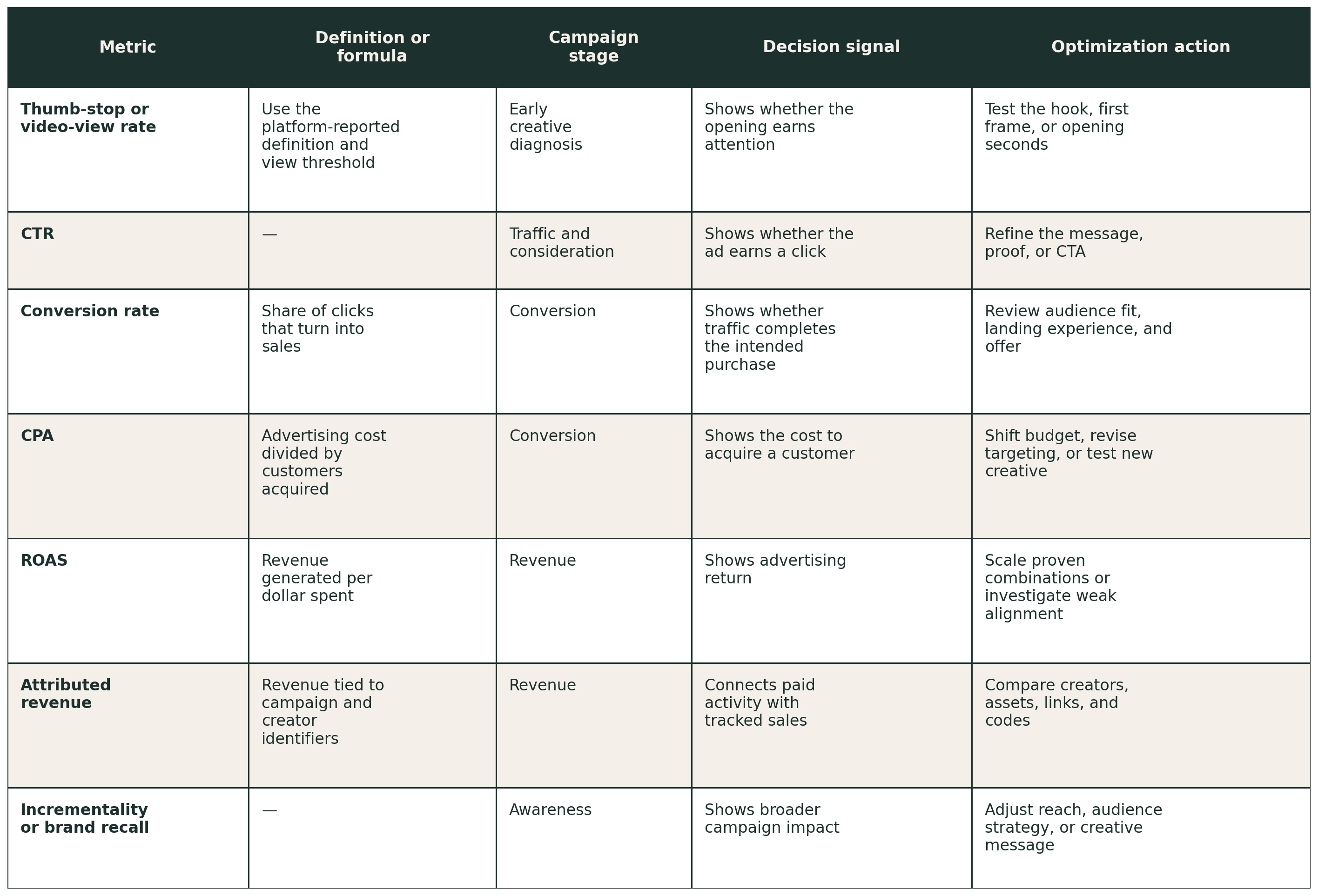
Assign an owner and reporting cadence to every primary KPI. Record the result beside the asset ID and test hypothesis, rather than leaving performance data only inside the advertising platform.
Turn results into the next brief and budget decision
Use UTM parameters on every paid creator campaign. Assign unique affiliate links and promo codes by creator so clicks, conversions, and sales can connect to a specific person and post.
Keep these identifiers consistent across paid amplification and creator reporting. Aspire can generate unique tracking links and distribute custom promo codes tied to creator performance.
A practical attribution workflow should:
- Separate organic-post performance from paid-media performance.
- Retain campaign and creator identifiers in links and codes.
- Reconcile platform reporting with analytics and order data.
- Use incrementality testing when the objective extends beyond immediate conversions.
- Feed the findings into creator selection, briefs, production, and renewal decisions.
Keep strong assets in an evergreen creator library, but track their rights dates and creative performance. Refresh hooks, formats, and creator concepts when results show signs of fatigue.
FAQ
How do you get creator ad permissions before a campaign launches?
Add explicit paid usage, editing, channel, duration, renewal, and creator-handle authorization terms to the agreement before production. Keep a permission record that identifies the approved asset and the advertising account allowed to activate it.
How do you choose between running a allowlisted or Partnership Ad, and repurposing creator content for a brand-run ad?
Choose based on the level of control and creator identity the campaign needs. Creator-handle formats retain the creator profile, and repurposed ads give the brand more freedom to edit and test variants. Confirm the activation path during briefing so the creator can supply the correct files and permissions.
How should a brand compare creator ads with studio-shot brand ads?
Run both creative types under the same objective, audience, budget, optimization event, placements, and timing. Preselect the decision metric and record any delivery differences that could affect the comparison.
How can marketers attribute conversions across organic creator posts and paid creator ads?
Use separate UTM parameters, affiliate links, and promo codes for each creator, post, and paid activation. Preserve the original content ID in analytics and order records so the team can distinguish creator-driven organic sales from conversions attributed to paid delivery.
Final launch checklist
Before launching, confirm that the campaign has:
- Creators selected for audience overlap, content fit, engagement patterns, and brand safety
- Written paid usage rights
- Clear usage duration and renewal terms
- Disclosure and approval requirements
- Tracking links and creator-specific promo codes
- Pixels or other conversion tracking
- Approved source files and asset variants
- Platform permissions for creator-handle ads
- Consistent campaign and asset naming conventions
- A single-variable test plan
- One primary decision metric for each test
- Defined KPI ownership
- A reporting cadence
- Rights-expiry and renewal tracking
Audit your existing creator content for rights status and organic signals. Then launch a controlled paid test using the strongest eligible assets.