Turn Creator Content into High-ROI Partnership Ads

Turn creator content into high-ROI Partnership Ads with lower CPA, higher CTR, and measurable social commerce revenue.
Meta's partnership ads deliver, on average, 19% lower CPA and 13% higher click-through rates than standard ad formats. That efficiency gap is the reason paid social teams keep pulling creator content into their media plans. The content already earns trust, and the media budget scales it.
Why Creator Content Belongs in the Paid Media Mix
Organic creator content earns attention because audiences recognize a real person behind the recommendation. The problem is that attention alone doesn’t drive results. A viral Reel can spike engagement for a week and then fade, taking its reach with it.
Influencer marketing in paid advertising stretches that limit. When you put media budget behind proven creator content, you convert a one-time organic moment into a distribution channel you can measure, control, and repeat. Getting there takes three things: paid distribution with targeting, explicit usage rights, and conversion measurement that ties spend to revenue.
This guide walks the full path. You’ll learn how to find creators who can convert, spot the organic content worth scaling, secure the rights to run it, launch Partnership Ads with deliberate targeting, test creative and audiences cleanly, connect the ads to shoppable checkout paths, and measure the revenue they produce. Here’s the repeatable operating model for testing and measuring creator content in paid media.
What Are Partnership Ads?
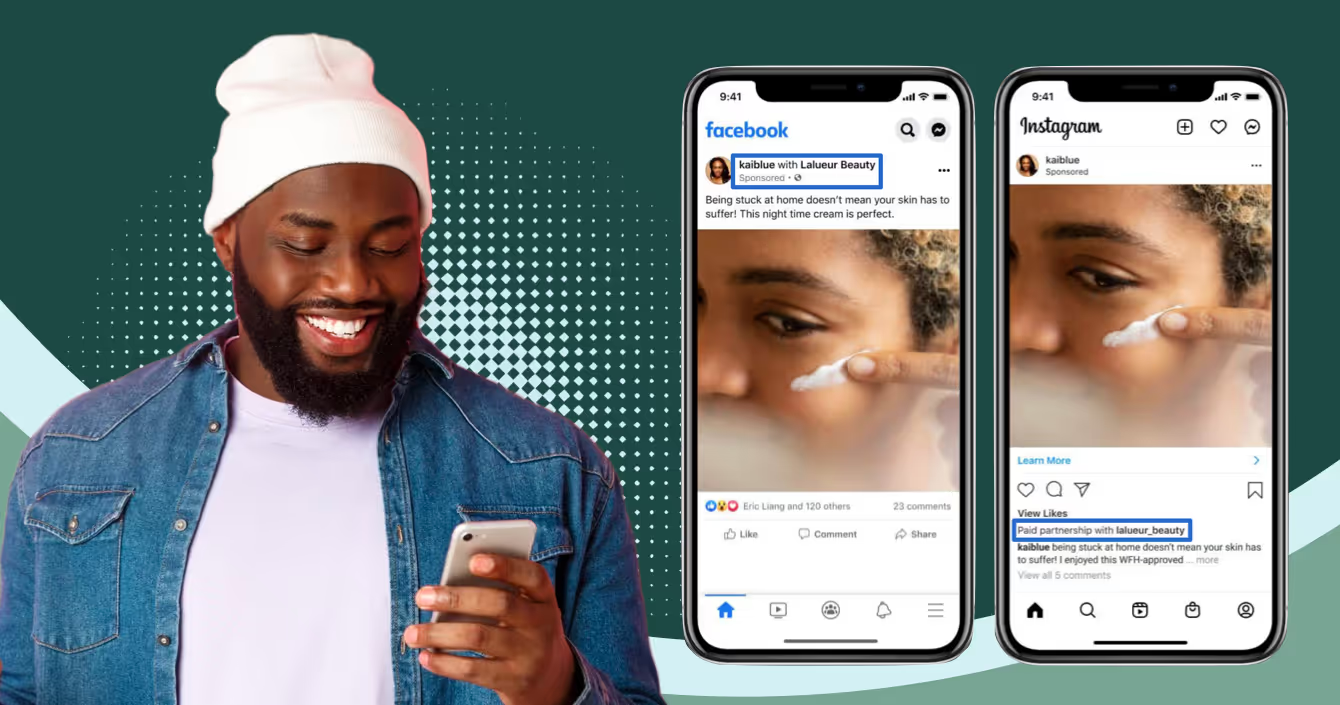
Partnership Ads are Facebook and Instagram ads that a brand funds and manages but runs from a creator's handle, with both the creator and the brand shown in the ad header. Audiences see a genuine creator post carrying the credibility of that creator's own feed, with the brand named as a formal collaborator.
The creator supplies the content and the social proof, while the brand controls the media budget, the campaign objective, the targeting, and the optimization. You get the authenticity of a creator recommendation with the precision of paid social in one unit.
How Partnership Ads Differ From Standard Paid Social Ads
A standard paid social ad runs from your brand page, so the audience knows immediately that a company is talking to them. A Partnership Ad runs from the creator's account, so the recommendation reads as a real person's endorsement.
The mechanics behind the scenes stay familiar. You still set the objective, define the audience, control the budget, and read the performance data. What changes is the creative source and the perceived voice, and that shift is what drives the efficiency difference Meta reports. Meta also recently rolled out AI-driven tools inside Ads Manager to identify, evaluate, and convert creator content into paid ads.
Why Partnership Ads Matter for Social Commerce
Influencer marketing for social commerce works because purchase decisions increasingly start with a creator rather than a search bar. Partnership Ads let you use creator-led product discovery to send audiences straight to a shoppable destination: a tagged product, a product-detail page, an affiliate link, a promo-code offer, or an in-app checkout path.
The shopping surfaces are already built in. Instagram Shopping lets brands and creators tag up to five products in feed posts, Stories, Reels, and Lives. The same creator asset that earns attention can also carry the tap-to-buy path, shortening the distance between discovery and checkout.
Build a Creator Program That Produces Ads Worth Scaling
Paid amplification starts with a healthy organic program. You cannot scale content that never existed, and you cannot pick winners from a pool of one. Build the creator base first, then let performance tell you what to promote.
Choose Creators for Conversion Potential
Follower count is a weak selection signal. A large audience with poor product fit produces reach and little conversion. Prioritize audience alignment, engagement quality, authentic product fit, and evidence that a creator can move people toward consideration or purchase.
Read the engagement that indicates depth. Comments, shares, and saves show a stronger connection to a post than likes alone. Watch time, meaningful comments, and any available conversion signals tell you more about paid potential than a raw like count.
Start small and build relationships. A practical starting point is 5 to 10 micro-creators in your niche, then grow those into ongoing ambassador relationships rather than a string of one-off posts. Choosing creators for their fit with your brand's voice and audience matters as much as their metrics. When you connect creator selection to shoppable, revenue-oriented content, influencer marketing for social commerce becomes a program you can scale.
Brief for Authenticity and Ad Adaptability
A good creator brief sets goals, key messages, product requirements, and clear guardrails while leaving the creator's own voice intact. Skip word-for-word scripts. When content reads like a read-aloud ad, it loses the credibility you hired the creator for. Let influencers narrate the product in their own context and explain why it matters to their audience.
Ask for a strong hook in the first few seconds, several usable formats, and the product shown in a realistic use case. Request vertical 9:16 assets for Reels and Stories and 4:5 assets for feed placements during the initial brief. Capturing the right aspect ratios up front saves you from awkward cropping when you move content into paid.
Set Rights and Permissions Before Content Takes Off
A brand cannot legally use creator content in paid advertising without the creator's explicit permission. If you skip this step, you’ll be scrambling once a post performs well.
Include Paid Usage Rights in the Creator Agreement
Handle paid amplification rights at the contract stage, before anything publishes and long before you review performance. Waiting until a post takes off puts you in a weak negotiating position and can stall a campaign at its best moment.
Spell out the terms in the agreement:
- Permitted channels and placements
- Usage duration and renewal terms
- Whether the brand may edit, crop, remix, or repurpose the asset
- Compensation for paid usage
A 6 to 12-month usage term is a standard starting point for paid creator-content rights. You can also consider a performance-bonus clause tied to paid results. The incentive is optional, but it encourages rights approval and aligns the creator's incentives with the outcomes you care about.
Use the Right Permission Path for Partnership Ads
There are 2 permission routes. You can set up allowlisting through Meta Business Manager, or use an influencer marketing platform like Aspire that has a native integration with Meta. Both let you run the ad from the creator's handle with your targeting applied.
Either path requires the creator to have a professional Instagram account to grant permissions through an ad code or Creator Marketplace. Confirm that account status early so you do not discover the gap at launch.
Turn Organic Winners Into Partnership Ads
This is the practical organic-to-paid workflow. Treat organic performance as a screening signal rather than proof of paid success. A post that thrives with a creator's existing followers may or may not convert a cold audience, and the only way to know is to test it as an ad.
Identify Organic Content With Paid Potential
Look for candidate posts with meaningful engagement, strong watch time, clear product presentation, audience fit, comments that signal purchase intent, and organic clicks or conversions where you can see them.
Meta's updated Partnership Ads Hub helps here. A new "All" tab surfaces UGC, affiliate posts, and brand mentions, and advertisers can access creator-performance metrics including views, likes, comments, shares, and saves to judge which assets merit scaling.
Adapt the Creative Without Removing Its Creator Voice
A single creator asset can become several Partnership Ads. Adjust the aspect ratio for each placement, trim the opening to reach the hook faster, add captions for sound-off viewing, test text overlays, and swap the call to action. Each variation gives you a clean read on what drives response.
Keep the creator-native look intact. Shorten a Reel for a feed placement and add light captions for clarity, but don’t over-polish it into a conventional brand ad. The lo-fi, authentic quality is the asset, and heavy editing removes the quality that made it work.
Launch With Deliberate Targeting
A Partnership Ad campaign gives you more control than boosting an existing post, which hands delivery to the platform's defaults. A proper campaign defines the objective, budget, targeting, placements, and measurement, so you can read and repeat the result.
Run creator ads in separate campaigns or ad sets rather than mixing them into existing brand creative, so your performance comparisons stay clean. For targeting, use these 3 proven approaches:
- Retarget warm site visitors and people who engaged with the content
- Apply standard interest and demographic targeting for prospecting
- Build lookalike audiences from the creator's own followers
Partnership Ad Implementation Checklist
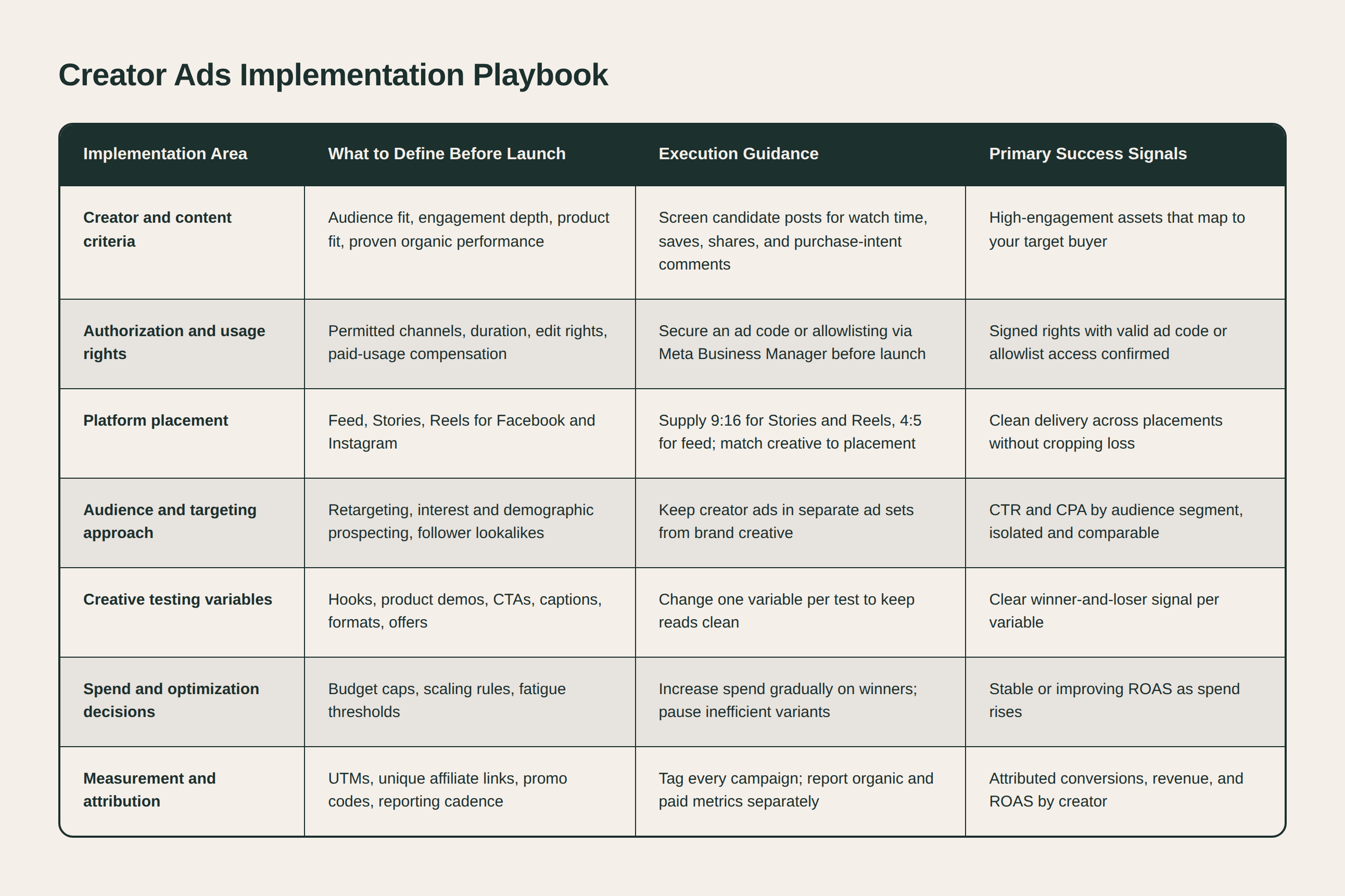
Every paid creator-content campaign needs shared ownership across creator marketing, legal or operations, paid media, and analytics. If any of those functions works in isolation, there’s a risk of something breaking at launch. Use this table as an operational reference before you publish.
Before you hit publish, confirm the following:
- Permissions are secured with a valid ad access
- The landing page or checkout path is live and ready for traffic
- Tracking links or promo codes are in place and tested
- Creative variants are built for each placement
- Audiences are defined and separated by strategy
- Budget limits and scaling rules are set
- Reporting cadence is agreed across teams
Aspire connects these pieces through creator links, promo codes, co-branded storefronts, paid amplification, and attribution and lets teams request permissions, set up campaigns, and read combined organic-plus-paid reporting through its CreatorAds Suite.
Centralize the repeatable work, from approvals and permission requests, to tracking and reporting. Keep human judgment for creator fit, creative context, and scaling calls. That balance keeps a growing program from stalling under manual approvals while preserving control over how the creative looks.
Test, Optimize, and Scale the Ads That Drive Revenue
Paid creator advertising works as an ongoing testing loop. The first version of any ad is a hypothesis. Your data decides what stays, what scales, and what gets cut.
Run Clean Creative Tests
Start with a head-to-head test between creator content and studio-shot brand creative. Use the same audience and the same budget, change only the creative, and compare ROAS and CPA. This single test tells you whether creator content earns its place in your media mix and by how much.
From there, expand your testing variables one at a time: creators, opening hooks, product demonstrations, calls to action, captions and overlays, formats, placements, audiences, landing pages, and offer structures. Watch how CPC and CPA shift as you swap the creative. Change too many things at once and you lose the read.
Make Budget Decisions From Business Metrics
Organic engagement helps you prioritize which content to test, while paid results decide media allocation and scaling. Confusing the two leads to spend on content that looked strong in a creator's feed but never converted a cold audience.
Move budget with discipline, following the scaling rules in the implementation checklist above.
Feed Paid Learnings Back Into Creator Strategy
Your testing loop becomes a discovery engine. Paid results should shape future creator discovery and briefs. When you see which creator styles, products, hooks, and audience segments produce conversion value, you can brief the next round of creators against evidence instead of instinct. For more detailed A/B testing and creative-variation guidance, click here.
Connect Partnership Ads to Social Commerce Revenue
A creator ad only earns revenue if it lands somewhere people can buy. Even strong creative underperforms when it sends traffic to a product page that fails.
Reduce the Distance Between Discovery and Checkout
The shoppable destination should sit as close to the ad as possible, whether that is an in-app product tag, a product-detail page, a creator storefront, an affiliate link, or a unique promo-code offer. Additional steps between the ad and checkout tend to increase abandonment, so keep the path short.
Different platforms shorten that distance differently. For example, TikTok Shop creator videos can carry direct, tappable product links, and creator-led live shopping lets viewers ask questions and buy during the stream. That live format creates urgency and delivers social proof in real time.
Before you spend, confirm the launch-readiness items in the implementation checklist above. A strong ad cannot compensate for a confusing product page, an out-of-stock SKU, a weak offer, or a broken attribution path.
Use Incentives and Attribution to Tie Creators to Sales
Affiliate links and promo codes let you identify the clicks and conversions each individual creator drives, so give every creator a trackable link and a distinct code, and attribution stops being guesswork.
Pay for both quality and results with a hybrid structure (a base fee + commission on sales). A commission-only model can deter strong creators or push content toward a hard-sell tone. The base fee supports good content while the commission ties compensation to conversion. By tagging and leveraging affiliate marketing across Instagram, TikTok, and YouTube, you can turn creator posts into a working storefront.
Measure Partnership Ad ROI Without Confusing Reach for Revenue
Reach and revenue measure different things, so keep them in their proper places by defining a measurement hierarchy.
Use impressions, reach, video views, engagement, and CTR to diagnose delivery and creative response. Those metrics tell you whether the ad is being seen and whether the creative lands. Use conversion rate, CPA, ROAS, attributed revenue, and incremental revenue to judge commercial performance, since those decide whether the campaign made money.
Track Paid Performance and Creator-Sourced Revenue Separately
Understand the difference between direct attribution and incremental value. Direct attribution ties a tracked sale to a creator's link or code. Incremental revenue asks a harder question: did the campaign generate outcomes beyond what would likely have happened anyway?
Holdout tests and geo tests are optional advanced methods for measuring incrementality. Don’t just present platform-level results as proof of incremental revenue unless the campaign design includes an incrementality method.
Build a Full-Funnel Reporting View
Report organic creator metrics and paid-ad metrics side by side, and keep them as distinct totals. Label the date range, attribution window, spend, campaign objective, and source of each metric so nobody misreads the picture.
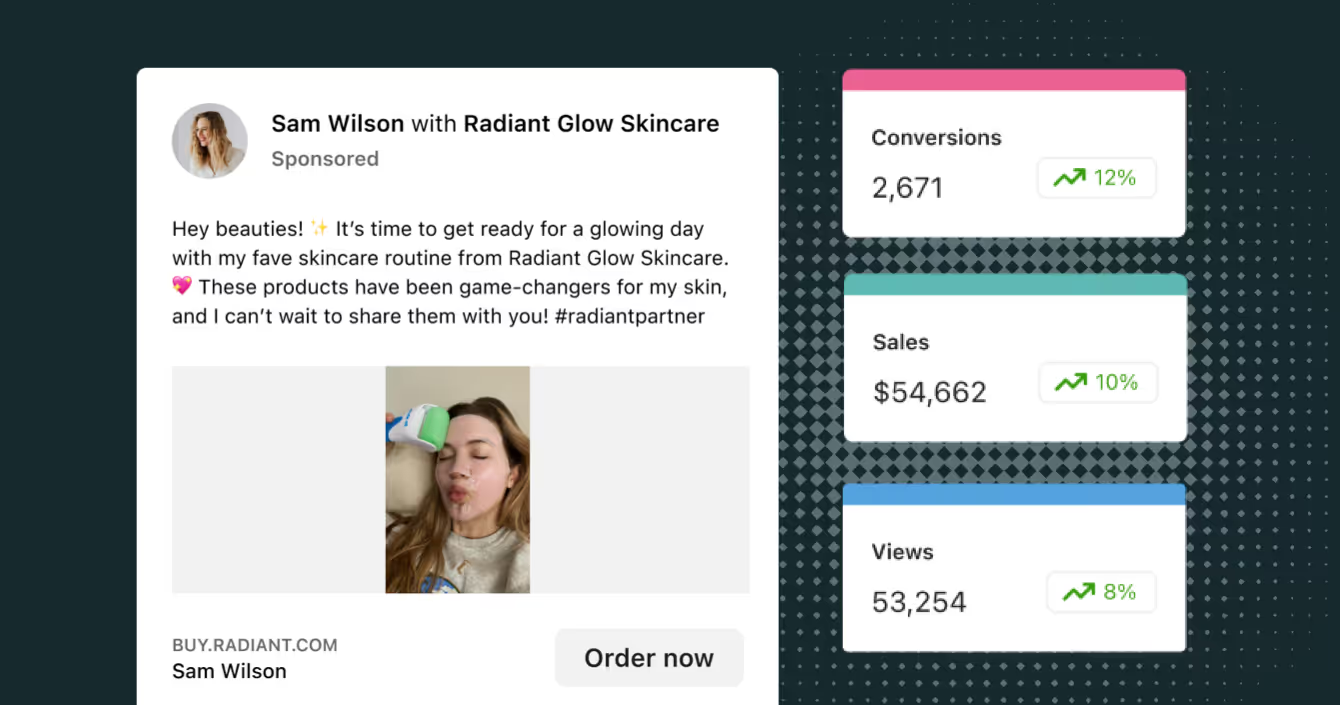
Include these fields in your reporting: creator, content asset, platform, audience, campaign objective, spend, impressions, clicks, CTR, conversions, conversion rate, CPA, revenue, ROAS, promo-code sales, affiliate-link sales, and creative learnings. Aspire's CreatorAds Suite can show paid metrics such as impressions, clicks, and conversions alongside organic post metrics.
What to Look for in Influencer Marketing Software for Paid Amplification
Pick software by the workflow it supports rather than a feature checklist. The teams that scale creator amplification well are the ones that stop passing files and approvals between disconnected tools.
Look for capabilities that cover the whole path:
- Creator discovery and relationship management
- Content collection and asset organization
- Rights and permission requests
- Paid campaign launch with audience and budget controls
- Tracking links and promo codes
- Ecommerce attribution
- Combined organic-plus-paid reporting
A centralized workflow matters most when you grow from a small creator cohort to a larger ambassador program. Every manual handoff between creator, legal, paid media, and analytics is a place where a rights approval stalls or a tracking link breaks. Centralizing that work removes the friction that delays campaigns at scale.
Brands on Aspire can request ad permissions, publish directly to Meta or save an ad as a draft for Ads Manager, and track ad spend, sales generated, and ROAS over time. The CreatorAds Suite streamlines this whole process:
- Request Instagram ad rights when a creator tags a brand as a paid partner
- Set campaign objective, budget, schedule, and targeting directly inside Aspire
- Track paid and organic metrics in one dashboard
Build an Organic-to-Paid Creator Engine
The operating model is simple to state and demanding to run well. Invest in a creator base. Identify the authentic organic winners. Secure permission before you amplify. Adapt assets for paid placements while keeping the creator voice. Run controlled tests, connect ads to shoppable conversion paths, and scale only against revenue-oriented evidence.
Treat creator marketing and paid social as connected parts of one full-funnel system. The creator authenticity and community trust that make this work have to stay intact, or you lose the advantage that made partnership ads outperform in the first place.
The practical test is whether your current workflow can handle rights, launch Partnership Ads, and connect creator content to attributed sales in one place. If those steps live in separate tools and separate teams today, that is the gap worth closing. See how Aspire brings the full organic-to-paid workflow together for e-commerce brands.
Frequently Asked Questions
How do you measure Partnership Ad ROI when a customer does not use a creator's promo code?
Rely on the UTM parameters and tracking links attached to the paid campaign rather than the code alone. Those let you attribute the click and conversion to the specific Partnership Ad even when the buyer skips the code. For a fuller read on the campaign's true contribution, run a holdout or geo test to estimate incremental revenue, since direct attribution captures only the sales it can trace.
What is the difference between organic creator performance and paid Partnership Ad performance?
Organic performance measures how a creator's existing followers respond to a post in their feed. Paid Partnership Ad performance measures how a targeted, budgeted audience responds to that same content as an ad. Strong organic engagement is a screening signal for what to test in paid, though it does not predict paid results, because the audience and delivery are different.
When should a brand refresh creator ad creative instead of increasing budget?
Refresh the creative when frequency climbs and CTR or conversion rate starts falling on an ad that previously performed. That pattern signals fatigue, and adding budget to a fatigued asset raises cost without adding return. Increase budget only while an ad's efficiency holds steady or improves as spend rises.
Can one creator asset be used across multiple paid placements?
Yes, and it is efficient to do so, provided your usage rights permit it. Follow the placement-specific adaptations covered earlier in this guide, and confirm the contract covers the specific channels and edits before you repurpose the asset.
Which software capabilities matter most when scaling creator-content amplification?
Prioritize a connected workflow over any single feature, as detailed in the software section above. The value shows up as you grow, because a centralized workflow removes the manual handoffs between creator, legal, paid media, and analytics teams that otherwise stall campaigns.