.jpg)
How to Find Influencers for Your Brand on Instagram in 6 Simple Ways

Find Instagram influencers for your brand with 6 simple ways plus tips to vet creators for audience fit, engagement, and brand safety.
To find influencers for your brand on Instagram, start with people who already follow, tag, or discuss your products. Then review each creator’s audience, engagement quality, content, brand safety, and campaign cost before you contact them.
Instagram continues to be the top channel for influencer marketing because a growing number of people use it to discover products, follow creators, and share recommendations. Through influencer-generated content (IGC), brands can join those conversations with content that fits a creator’s established style.
But finding the right creator takes more than searching for accounts with large followings. Brands need to assess audience fit, engagement quality, authenticity, content quality, brand safety, and campaign cost before they make contact.
This guide explains how to find Instagram influencers manually and how an influencer marketing platform can help brands find and vet creators while simplifying influencer campaigns.
Before Sourcing Instagram Influencers
A clear campaign plan helps brands search with purpose. Define the following before reviewing creator profiles:
- Target audience: Identify the demographics, location, interests, and purchasing behaviors the campaign should reach. Creating buyer personas can help clarify the audience.
- Budget: Decide whether the budget supports one larger creator or several smaller creators. Guidance on setting a budget for influencer campaigns can help set realistic expectations.
- Campaign objective: Choose a measurable outcome, such as product sales, brand awareness, website traffic, content production, or follower growth.
- Content requirements: Define the formats, products, posting schedule, messaging, usage rights, and approval process.
- Success metrics: Decide how the team will measure reach, engagement, clicks, conversions, revenue, or return on investment.
Clear goals help a brand select suitable creators and write more useful content briefs. More guidance is available in this resource on setting influencer marketing goals.
What to Check Before Choosing an Instagram Influencer
Follower count provides limited information about whether a creator can support a campaign. Review the creator’s audience, content, performance, and commercial history together.
Instagram Influencer Vetting Checklist
- Audience demographics: Age, location, gender, interests, and purchasing relevance
- Audience authenticity: Unusual usernames, empty profiles, sudden follower increases, and low-quality engagement
- Engagement quality: Comments with substance, repeat commenters, average likes, shares, saves, and views
- Organic and sponsored performance: Whether sponsored posts perform close to the creator’s regular content
- Content quality: Visual style, storytelling, production quality, and content formats
- Posting consistency: Frequency, recent activity, and consistency across formats
- Brand fit: Values, tone, aesthetic, product relevance, and past topics
- Brand safety: Controversial content, undisclosed promotions, misleading claims, and risky associations
- Commercial history: Previous partnerships, category conflicts, and audience response to sponsored content
- Cost and rights: Rate, deliverables, exclusivity, usage rights, whitelisting, and campaign duration
Green Flags to Look For
- A healthy engagement rate: An audience that values a creator’s content usually interacts with it. A large following paired with very few likes or comments may signal an inactive or inauthentic audience. Review both organic and sponsored posts. The rates should be reasonably consistent when the creator integrates brand content well. Brands can calculate engagement rates using the steps outlined here. Engagement rates between 1% and 6% are generally considered good, with the right benchmark varying by platform, audience size, format, and industry.
- A strong content-to-follower ratio: An account with many followers and little original content may need closer review. A consistent library of quality posts makes it easier to evaluate the creator’s style and audience relationship.
- Genuine followers: Review a sample of the follower list. Look for complete profiles, profile pictures, regular posts, and normal interactions. Many empty accounts, random usernames, or profiles with no activity can indicate purchased or low-quality followers.
- Audience alignment: Compare the creator’s audience demographics with the campaign’s target audience. Review the people who regularly comment because they often show the strongest interest in the creator’s content.
- Relevant content and values: A creator’s topics, tone, and visual style should fit the brand. The partnership will feel more natural when the creator already discusses related products or interests.
- Original images and video: Use a reverse image search when a creator’s content appears copied or inconsistent. This can help identify reposted images presented as original work.
- Clear commercial practices: Review how the creator discloses partnerships and responds to sponsored content. Consistent disclosures and clear communication support safer partnerships.
A creator’s follower count should support the decision rather than determine it. Macro-influencers may have broad reach, but smaller creators can provide stronger relevance or engagement for specific audiences. Brands can compare nano-influencers and micro-influencers when deciding how to allocate campaign spend.
How to Find Influencers for Your Brand on Instagram
Manual discovery works well for focused searches and smaller campaigns. It lets a brand inspect content in context and understand how a creator presents products to their audience.
1. Review the Brand’s Follower List
Start with people who already follow the brand. Existing followers typically understand your brand’s products and values, which can make a partnership more natural.
Look for:
- Creators who already mention your brand or use related products
- Accounts with a relevant niche and audience
- Profiles with a visual style that fits your brand
- Followers who create original content about your category
- Accounts with consistent engagement and recent activity
A creator who already enjoys your brand will be more likely to produce influencer-generated content that feels credible and authentic.
2. Review Tagged Posts
The Tagged posts section of a brand’s Instagram profile can reveal creators who already talk about the brand. This is a form of social listening, which involves monitoring conversations about a brand across social channels.
To review tagged posts:
- Open your brand’s Instagram profile.
- Select the Tagged icon above the post grid.
- Review the accounts behind relevant posts.
- Check each creator’s audience, engagement, content quality, and brand fit.
- Save suitable profiles in a spreadsheet or creator database.
Posts with strong engagement can help identify potential partners, but likes alone do not confirm audience quality.
3. Search the Explore Page
Instagram’s Explore page recommends content based on the accounts a user follows and the posts they interact with. It can help brands discover creators with a relevant niche, style, or audience.
Use Explore to find:
- Related creators and content formats
- Relevant hashtags
- Location-specific accounts
- Product categories and emerging topics
- Content styles that may work for the campaign
Search results should still go through the same audience, authenticity, and brand-safety review as every other discovery source.
4. Review Recommended Accounts
Instagram recommends similar accounts after a brand follows a creator. These suggestions can reveal creators with related content, audiences, or aesthetics.
Recommended accounts may appear above the profile grid after selecting Follow. Brands can also select Discover people below the profile and then choose See All to view more suggestions.
Use these recommendations to expand a shortlist, but don’t assume that similar content means similar audience quality or campaign performance.
5. Research Competitor Activity
Competitors’ follower lists, tagged posts, and creator partnerships can reveal relevant accounts. Reviewing competitor activity can help a brand:
- Identify creators who already work in the category
- Find similar creators with a different audience or style
- See which content formats receive meaningful engagement
- Spot partnerships that may create conflicts
- Learn which approaches appear ineffective
Your brand should check exclusivity, category conflicts, and audience overlap before approaching a creator who has worked with a competitor.
Using Software to Find Influencers for Your Brand
Manual research becomes difficult when a campaign requires many creators, multiple audience segments, or detailed performance comparisons. Spreadsheets and Instagram search can help with a short list, but they make it harder to standardize vetting, track outreach, compare rates, and connect discovery with campaign reporting.
An influencer marketing tool usually supports one task, such as creator search, social listening, reporting, or payments. An influencer marketing platform connects several workflows in one system. A scalable platform may include:
- Creator search and filtering
- Audience demographics and performance data
- Authenticity and brand-safety checks
- Outreach and relationship management
- Content briefs, approvals, and campaign workflows
- Payments or affiliate tracking
- Performance and return-on-investment reporting
Brands comparing influencer marketing tools should map each product to the campaign workflow rather than compare feature counts alone.
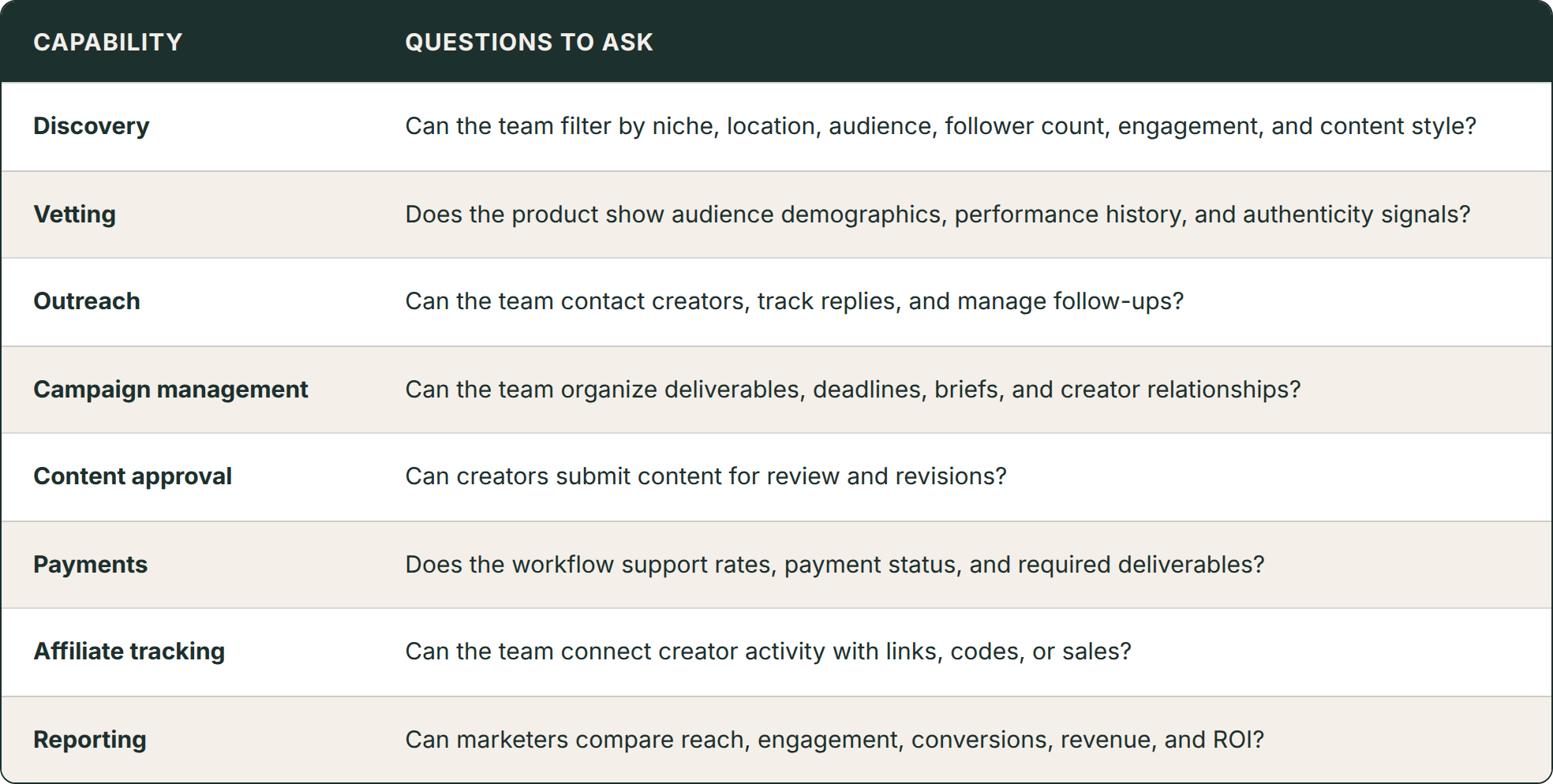
For e-commerce brands, the best influencer marketing software should connect creator discovery with product seeding, campaign operations, content reuse, sales tracking, and reporting. The right choice depends on campaign volume, sales channels, team size, budget, and the level of workflow automation required.
6. Use an Influencer Marketing Platform
An influencer marketing platform can help teams find and organize Instagram creators without relying on disconnected searches and spreadsheets. It can also connect discovery with campaign execution.
Aspire’s influencer marketing tools support the discovery steps described above. Teams can:
- Search pre-vetted influencers using filters for follower count, engagement rate, audience demographics, and other criteria.
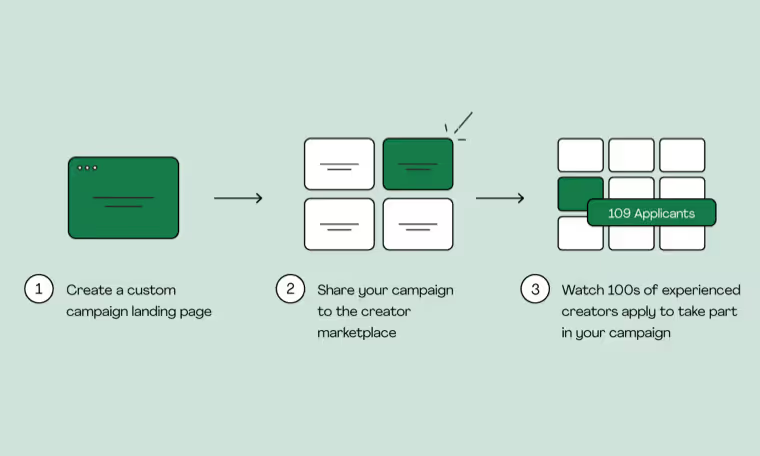
- Use a Creator Marketplace to publish upcoming campaigns and receive creator applications.
- Monitor conversations about the brand with social listening tools.
- Create branded application pages for campaigns shared through owned channels.
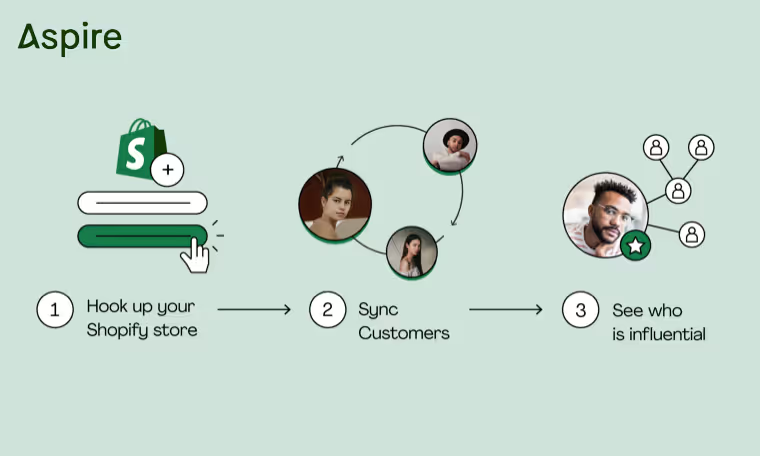
- Use a Shopify integration to identify existing customers with influence online and add suitable customers to campaigns.
- Find creators with a desired visual style using Image Search.
- Add Instagram creators directly to campaigns with the Aspire Chrome extension.
This workflow helps teams move from Instagram influencer discovery to creator selection and campaign coordination. Aspire can help brands manage creator campaigns as their program grows.
Moving From Discovery to Campaign Execution
Finding an influencer is only the first step. Before contacting a creator, prepare the information needed to assess the partnership and manage it fairly.
Information to collect for each creator
Record the following fields in a spreadsheet or influencer marketing platform:
- Creator name, handle, and contact details
- Niche, location, and primary content formats
- Follower count and average views
- Engagement rate and typical comment quality
- Audience demographics
- Recent sponsored and organic performance
- Previous brand partnerships
- Brand-safety notes and potential conflicts
- Proposed rate and deliverables
- Content usage rights and exclusivity terms
- Campaign status, deadlines, and results
This structure makes it easier to compare creators against the campaign objective. It also prevents a strong visual profile from overshadowing weak audience fit or unclear commercial terms.
When to move beyond manual discovery
A platform becomes more useful when a brand needs to:
- Review dozens or hundreds of creators
- Compare audience data across multiple profiles
- Run campaigns across several markets
- Track outreach and follow-ups
- Manage content approvals and deadlines
- Coordinate payments or affiliate activity
- Connect creator activity to sales or ROI
- Maintain a searchable record of past partnerships
Teams can continue using manual research for individual creators while adding them to a central campaign workflow through Aspire’s creator discovery tools.
Finding Instagram Influencers With Aspire
Aspire helps e-commerce brands find Instagram influencers and manage influencer campaigns, simplifying influencer discovery and campaign workflows.
The platform can support teams that want to:
- Find creators based on audience, performance, and content criteria
- Invite creators to apply for campaigns
- Add creators to campaigns
- Identify existing customers who may become creators or ambassadors
Brands can learn more about finding influencers with Aspire or explore the platform to see how it fits their Instagram influencer marketing workflow.
Frequently Asked Questions
What is an influencer marketing platform, and how is it different from an influencer marketing tool?
An influencer marketing tool usually addresses one part of the process, such as discovery, outreach, content management, or reporting. An influencer marketing platform brings several of those functions together so teams can find creators, manage relationships, coordinate campaigns, and measure results in one workflow.
How can a brand find Instagram influencers without software?
A brand can search its follower list, tagged posts, Explore recommendations, suggested accounts, relevant hashtags, and competitor activity. Each creator should then be checked for audience fit, engagement quality, authenticity, content quality, brand safety, previous partnerships, rates, and usage rights.
How should brands evaluate Instagram engagement quality?
Review average likes, comments, shares, saves, and views across several recent posts. Read the comments for meaningful interaction and look for repeat commenters. Compare sponsored posts with organic content, then check whether the audience appears genuine and relevant to the campaign.
Which data should brands compare before contacting a creator?
Compare audience demographics, location, niche, average views, engagement rate, content formats, posting consistency, sponsored-content performance, prior partnerships, brand-safety considerations, rates, deliverables, and usage rights. The most useful data depends on the campaign objective. Sales campaigns may prioritize audience purchasing relevance and conversion history, while awareness campaigns may prioritize reach and video views.
What should e-commerce brands look for in influencer marketing software?
E-commerce brands should look for creator discovery, audience and performance data, outreach, campaign management, content approval, payments or affiliate tracking, product workflows, and ROI reporting. Shopify connectivity can also help brands identify influential customers and connect creator activity with commerce data.
How does Aspire help brands move from discovery to measurement?
Aspire helps teams search for suitable Instagram influencers, invite creators to campaigns, use Shopify-related workflows, and organize influencer campaigns through its influencer marketing platform.