How to Brief Creators for "Boost-Ready" Content

Write briefs that turn creator content into high-performing ads. Master influencer marketing in paid advertising and get boost-ready content from day one.
69% of brands say influencer content outperforms brand-directed content. To extend that impact, put paid spend behind organic creator content. Adding Partnership Ads to always-on campaigns lifts click-through rates by 53%.
That means you need to change how you brief creators. Most influencer briefs are written for a single organic post. Then the post performs, someone on the paid team asks to boost it, and the whole project stalls on missing usage rights or a video shot in the wrong aspect ratio.
A boost-ready brief closes that gap. It tells the creator what to make, secures the permissions you need, and hands your paid team an asset ready to run on day one.
Here’s how to write one.
What "Boost-Ready" Content Actually Means
Before you brief anyone, you need to name the path the content will take. There are 3, and the differences matter for both your lawyers and your creative team. Getting influencer marketing in paid advertising right starts with picking the right format up front.
Organic Influencer Content
Organic influencer content is posted natively by a creator to their own feed, promoting a brand to an engaged audience. Through influencer-generated content (IGC), creators promote a brand's products to their followers in return for payment or free product. No media spend sits behind it, so reach is limited to the creator's existing audience.
Partnership Ads and Whitelisted Content
Partnership Ads and whitelisted content refer to a creator’s organic post that a brand puts media spend behind to run it through the creator's own handle. The original likes, comments, and shares stay intact.
Dark Posts
Dark posts are paid-only content that never appears on the creator's public feed. Instead, the content runs from the brand's own ad account.
A boost-ready brief has to specify up front which of these 3 paths the content is being made for. That choice changes what you need to secure legally and creatively.
Why Creator Content Outperforms Brand-Made Ads in Paid Social
The performance case for using creator content for ads is strong, and it holds up across the funnel.
In fact, Partnership Ads on Instagram generated an 82% increase in the possibility of purchase outcomes and a 2.4x lift in conversions. Turning that same creator content into paid social ads can produce 4x higher click-through rates and 50% lower cost-per-click versus standard ads.
White paid social audiences scroll past anything that feels like an ad, creator content reads like a recommendation from someone they know. When you combine that authentic trust with the precise targeting of paid media, you get the best of both worlds.
Earned Media Value, or EMV, is a useful lens here. Think of it as the equivalent paid-media cost of the organic reach and engagement a post already earned. Brands use it to decide which organic wins deserve a media budget. A post that earned strong reach organically has already proven it resonates, which makes it a lower-risk candidate for spend.
Lock Down Usage Rights Before You Brief a Single Creator
You cannot legally run a creator's content as a paid ad without the right permissions. The best time to handle this is the contract stage, not after a post takes off.
What Belongs in the Contract
We recommend building these terms into every creator agreement:
- Which channels the content can run on across social platforms.
- Duration of usage rights, typically 6 to 12 months minimum.
- Permission for paid promotion and boosting.
- Permission to make post-production edits and modifications.
Tie usage rights to performance bonuses so creators share in the upside. Spell the terms out concretely in the brief itself. You can even phrase a line item as simply as "usage rights: paid media, 3 months.”
How to Ask for Rights Without Killing the Relationship
Frame the ask as a collaboration, not a demand. If you already know you want to test a creator's content in ads, negotiate paid usage rights into the brief and contract from day 1.
On Aspire, you can do so by following these simple steps:
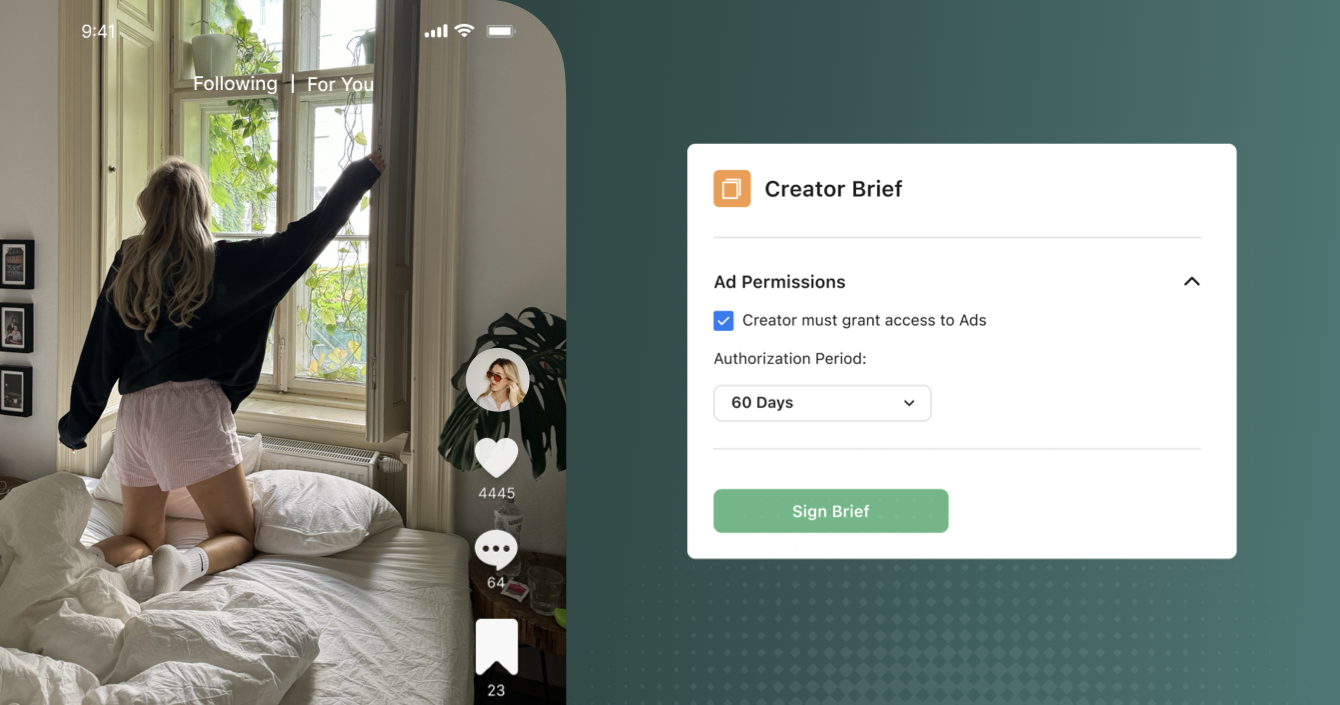
- In the ‘Send Briefs’ tab of your campaign workflow, select the ad permissions you need (i.e. Instagram Paid Partnership Ads, TikTok Spark Ads, etc.).
- Set the dates, which triggers an in-brief ‘Grant Access’ prompt so creators approve ad rights in one click.
- Track approval status in your Ad Permissions dashboard under Reporting.
- Set compensation that reflects both content creation and usage rights, since creators are granting more than a standard post.
By doing so, you can easily request ad permissions and manage usage rights directly inside creator agreements instead of over email or spreadsheets. You can also send personalized briefs with timelines and guidelines through a single platform.
The Boost-Ready Brief Checklist: Creative Specs That Make Content Ad-Ready
Turn this into a checklist your team can copy.
Hook-First Creative Direction
The opening seconds decide whether a paid social viewer keeps watching. Brief the hook first, not last.
- Keep the core product or text in the middle two-thirds of the frame. This keeps assets platform-agnostic and placement-agnostic.
- Run a small, focused test set. Pick 1 SKU and around 5 creators from a defined demographic segment, for example 1 bestselling product and 5 creators in a specific age range, rather than spreading one brief across many SKUs. This gives you a clean read on what drives performance.
- Ask creators to submit their voiceover video without captions or on-screen text. Then your team can layer captions and calls to action to fit each ad variation afterward.
Format and Caption Requirements
Nail the specs so the content drops straight into ad manager:
- 9:16 for Reels and TikTok
- 4:5 for the Instagram feed
For captions, keep them conversational. Use minimal text overlays, and only if they feel natural. Let the creator's own tone and phrasing lead instead of adding a corporate voiceover.
And remember, one asset can become many. Pull high-quality stills from video for static ads, add text overlays or stickers, and re-cut longer videos into short, punchy clips for Reels and TikTok. Learn more about how to stretch every piece of content here.
Approval and Handoff Workflow
Set the process before content comes in:
- Set the deliverable quantity and type.
- Define a posting-window deadline.
- Launch and monitor.
Structure the brief document itself in 3 phases: the creative ask, brand and campaign and product info, and deliverables and process.
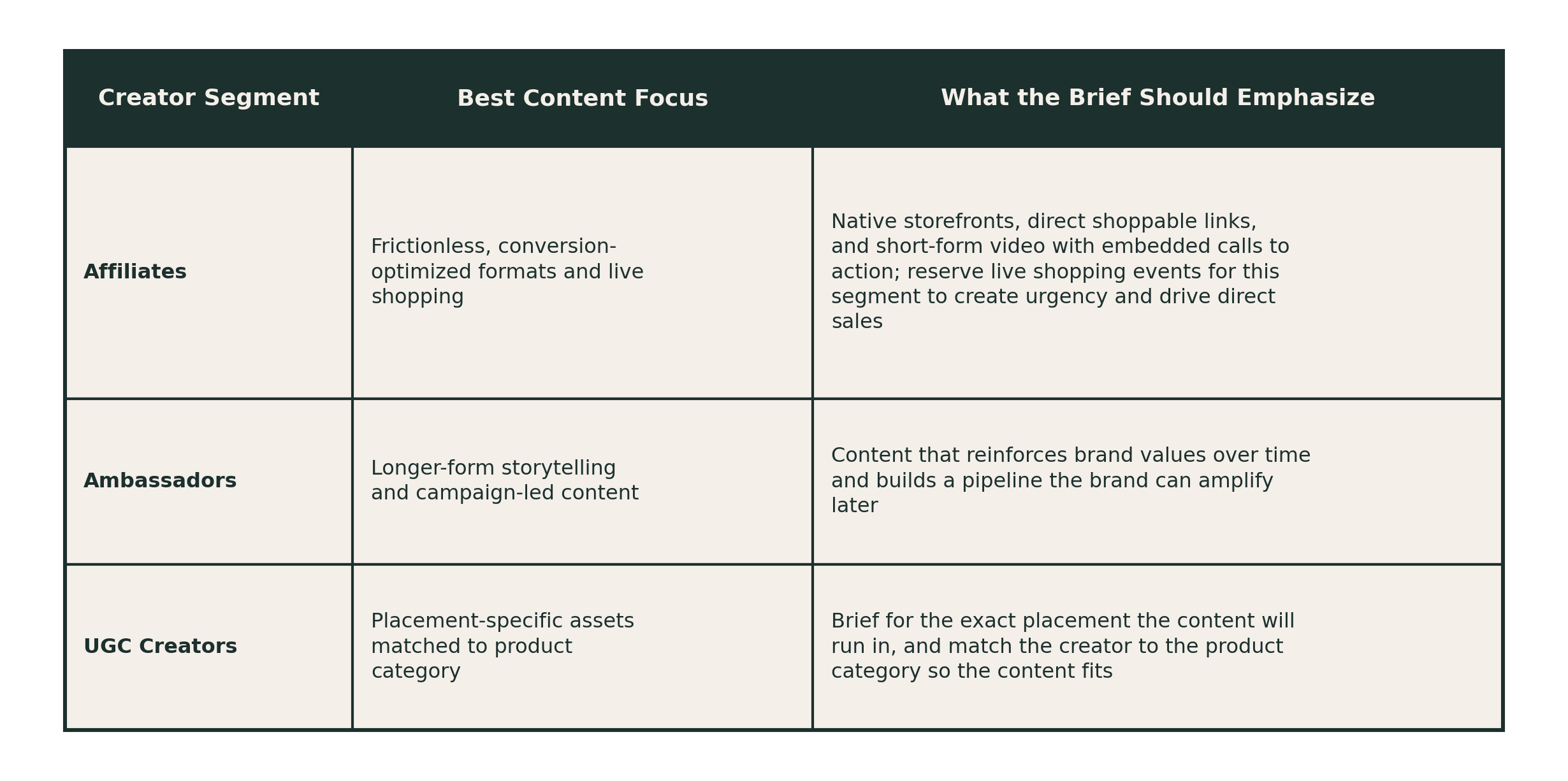
Brief by Creator Segment: Affiliates, Ambassadors, and UGC Creators
A single brief format does not fit every creator relationship. The segment should decide the brief's content focus, per Aspire's blog on segmenting a creator program for social commerce at scale.
Ambassador relationships are the clearest example. They are less about a one-off boosted post and more about building a longer content pipeline you can pull from later for paid amplification. That is where community and ambassador programs pay off over time.
A few formatting notes apply across segments: put clear, compelling calls to action directly on the video, optimize dimensions and safe zones for mobile viewing, and preserve the native, authentic feel while keeping basic brand compliance.
Launch Creator Content as Partnership Ads and Spark Ads
Once you have secured the content and the rights covered in the earlier sections, you launch, choosing from the same three methods: standard ads, whitelisted ads, and brand partnership ads. The mechanics differ by platform.
Meta Partnership Ads
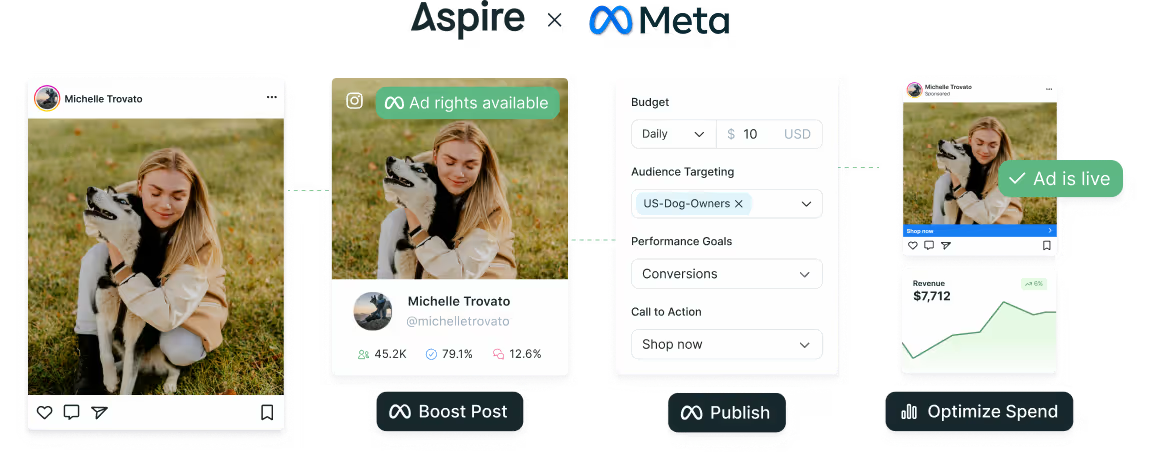
The creator grants the brand permission to run their content as a Partnership Ad through Partnership Ad codes and permissions. The brand then sets budget, targeting, and campaign goals.
TikTok Spark Ads
The creator toggles on ad authorization, chooses a duration, and shares a Spark code. The brand pastes that code into TikTok Ads Manager to confirm the post, then sets targeting and budget, per the same Partnership Ads Playbook source.

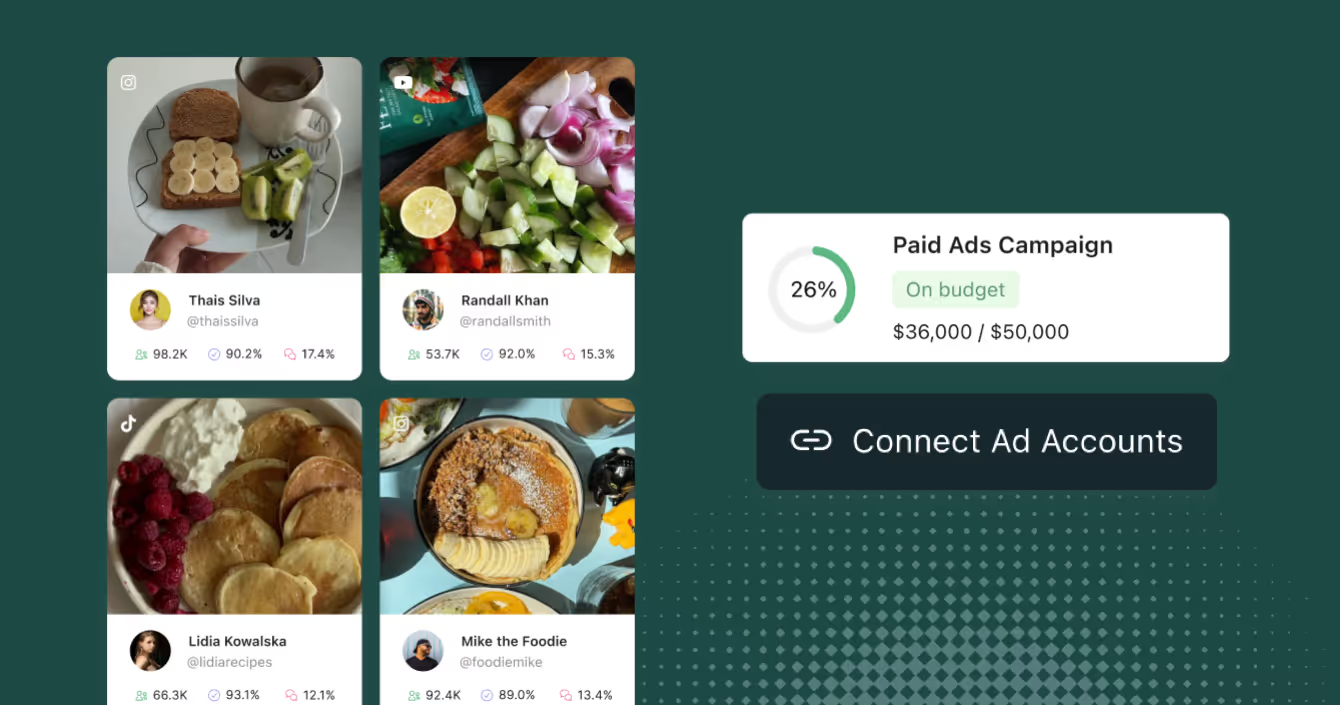
Aspire's CreatorAds Suite shortcuts these manual steps. When a creator tags a brand as a paid partner on Instagram, Aspire surfaces the post so the brand can request ad rights in one click, boost the post, and track paid and organic metrics side by side in one dashboard. This end-to-end automation removes the manual work without taking creative control away from your team.
Test, Measure, and Scale What Works
Treat creator ads like a testing lab, not a one-off boost. The cleanest test is a head-to-head: build two ad sets targeting the same audience with the same budget, change only the creative, and let ROAS and CPA settle whether creator content or studio-shot brand creative wins.
Set Your Testing Budget Split
We recommend this allocation:
- 70-80% of paid social budget on scaled winners in always-on campaigns.
- 15-25% on an active testing campaign with new creator ads cycling in every two weeks.
- 5-10% on retesting or re-cuts of promising assets.
Run each test cell for a duration floor of 7 to 14 days. Pre-commit to one success metric before launch, whether that is CTR, ROAS, CPA, hook rate, or thumb-stop rate, per the same framework post. Deciding the metric after the fact is how you talk yourself into a losing ad.
Match KPIs to Campaign Goals
Different goals need different scoreboards. So, break it down by campaign type.
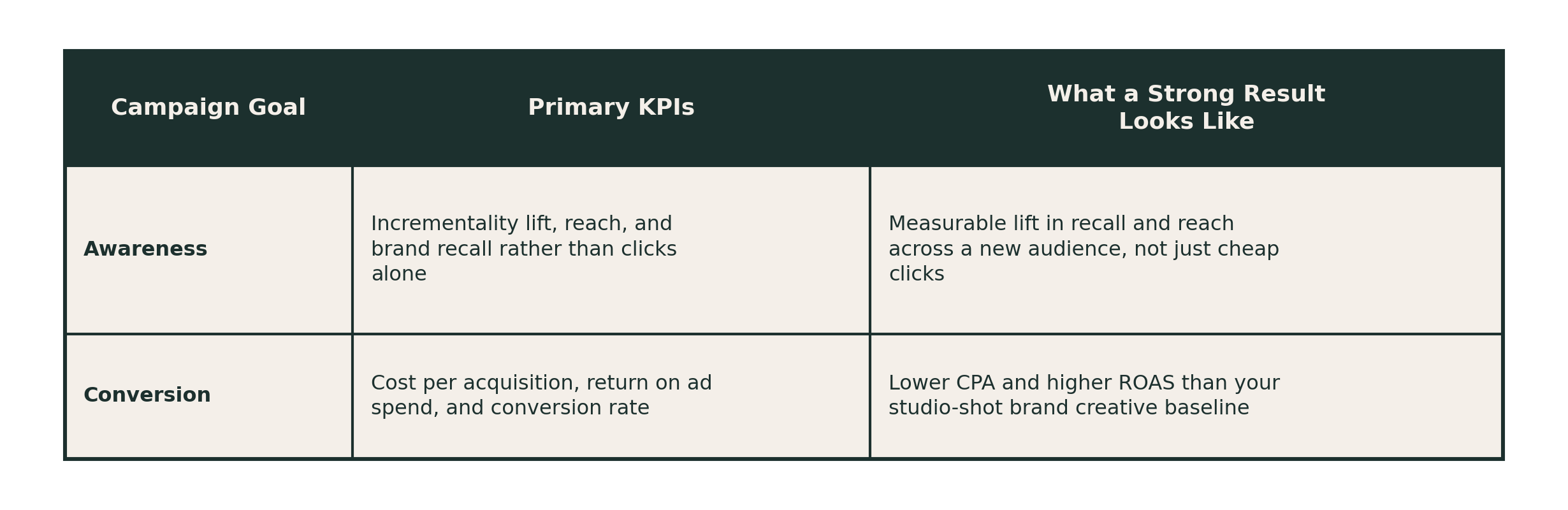
To tie a sale back to a specific post, use unique affiliate links and promo codes per creator. Track clicks and traffic, promo code usage and attributed revenue, conversion rate, and ROAS on boosted content.
PRO TIP: Document your learnings and share results back with the creators you tested. Most creators never see how their content performed as a paid ad. Closing that loop strengthens the partnership and gives your top performing creators a reason to make their next piece even sharper.
Frequently Asked Questions
What Is Earned Media Value (EMV), and Why Does It Matter for Paid Amplification?
EMV estimates what you would have paid to buy the organic reach and engagement a post earned on its own. For paid amplification, it works as a filtering tool. A post with high EMV has already proven it holds attention, so putting a media budget behind it carries less risk than boosting an untested asset. Use it to prioritize which organic wins graduate into paid.
How Many Ad Variations Should You Brief a Single Creator For?
Design variety at the variable level rather than asking for raw volume. A practical starting point is 1 clean voiceover video with no captions, which your team then cuts into several variations by adding different hooks, captions, or calls to action. Keep the number of creators small, around 5 per SKU, so each test cell produces a readable result.
Should Creator Content Run as a Dark Post or Through the Creator's Own Handle?
Run it through the creator's handle when authenticity and social proof matter, since the post keeps its likes, comments, and shares. Choose a dark post when you need to test many creative variations quickly, or run messaging you do not want on the creator's public feed. Both can work. The trade-off is trust signals versus creative flexibility.
How Do You Negotiate Paid Usage Rights for a Post That's Already Performing Well Organically?
Go back to the creator and negotiate paid usage rights for a set window, for example 30 days. Because you are asking for rights beyond the original agreement, expect to compensate for the added usage. Then hand the content to your ad team and test whether it scales in a paid environment before committing to a longer license.
What Is the Difference Between Influencer Marketing and Influencer Advertising?
The two differ in how creators reach an audience: marketing relies on creators posting to their own audiences, while advertising acquires creator content and runs it as paid media, often through the creator's handle. One builds trust over time. The other buys distribution against it.
Write your next brief for both the organic post and the paid ad from the start. Secure the rights, spec the creative for the ad manager, and match the brief to the creator segment.
Ready to turn your best creator content into Partnership Ads without the manual whitelisting steps? See how Aspire's CreatorAds Suite works.